Welcome to Roswell sign showing a UFO crashed into the sign. | Moab Republic
Roswell, a city located in southeast New Mexico, has a unique place in American history due to an intriguing event that occurred there in 1947. The history of Roswell is inextricably linked with unidentified flying objects (UFOs). The incident, commonly referred to as the Roswell UFO Incident, became one of the most famous and publicized UFO stories in the world. It happened when a local rancher discovered unidentifiable debris in his sheep pasture, which was later claimed by the military to be a crashed weather balloon, but many people believed it was the remains of an extraterrestrial spacecraft.
This incident forever embedded Roswell in popular culture and sparked a fascination with extraterrestrial life that continues to this day. It has significantly impacted the city’s tourism industry, attracting visitors from around the globe who are curious about the possibility of life beyond Earth. To acknowledge and embrace its unique history, in 2017, the city of Roswell erected a new city entrance sign. The “Welcome to Roswell” sign erected in 2017 not only greets visitors but also commemorates the city’s unique place in history. The sign, depicting a crashed UFO, reflects Roswell’s status as a hub for UFO enthusiasts and researchers.
Between 1966 and1967, writer and director Sergei Bondarchuk’s War and Peace (Война и мир) was released in four parts; a seven-hour-plus long adaptation of Tolstoy’s epic novel depicting the lives of several aristocratic families during the time of Napoleon’s invasion of Russia.
The stunningly beautiful film skillfully portrays personal stories amidst the political backdrop. Highly acclaimed, it won the Academy Award for Best Foreign Language Film in 1969, the Grand Prix in the Moscow International Film Festival, and the Golden Globe for Best Foreign Language Film.
The film stars Lyudmila Saveleva, Vyacheslav Tikhonov, and Sergei Bondarchuk as the main character, Pierre Bezukhov. Vasiliy Solovyov is a co-writer, along with Sergei Bondarchuk, based on the Leo Tolstoy novel.
War and Peace is the most expensive Soviet film ever made, costing 8.29 million Soviet rubles, which equates to approximately $70 million in today’s terms.
The sweeping masterpiece has been digitally restored by Mosfilm Cinema Concern, and is currently available on Criterion.
Last week I shared Elyer Ishmukhamedov’s first film, Tenderness, and this week let’s ride this summer feeling again with another film by Ishmukhamedov, Lovers. Lovers (Влюбленные) is a 1969/1970 film that portrays a summer of friendships, drama, and romance in Uzbekistan.
Ishmukhamedov has his own strange way of capturing the beauty of the season, especially in water scenes as we saw in Tenderness, and as in this vibrant and wonderfully bizarre watermelon/waterfall scene in the rain from Lovers.
Lovers was directed by Elyor Ishmukhamedov, written by Odelsha Agishev, and stars Rodion Nakhapetov, Anastasiya Vertinskaya, and Rustam Sagdullaev.
British artist Gluck was born into a wealthy, Jewish family as Hannah Gluckstein on August 13, 1895. Their father founded and ran the restaurant and hotel business J. Lyons & Co. in their London home, where Gluck was able to study the arts. Gluck passed away on January 10, 1978 in Steyning, UK.
Gluck defied gender roles, rejecting any forenames, and celebrated females and lesbian relationships in their paintings. Medallion is one of their most popular works and depicts Gluck and their partner, Nesta Obermer. Much of Gluck’s art focused on portraits, picturesque oceanic themes and floral paintings, and later aging and death.
Sketching on the Moors | Gluck
Still Life with a Scallop Shell and Blossom (1972) | oil on canvas | Gluck
Gluck wrote of one of their late paintings, Credo (Rage Rage Against the Dying of the Light), (1970-3), “I am living daily with death and decay, and it is beautiful and calming, All order is lost; mechanics have gone overboard – A phantasmagoric irrelevance links shapes and matter. A new world evolves with increasingly energy and freedom soon to be invisibly reborn within our airy envelope.”
Credo (Rage Rage Against the Dying of the Light), (1970-3) | Gluck
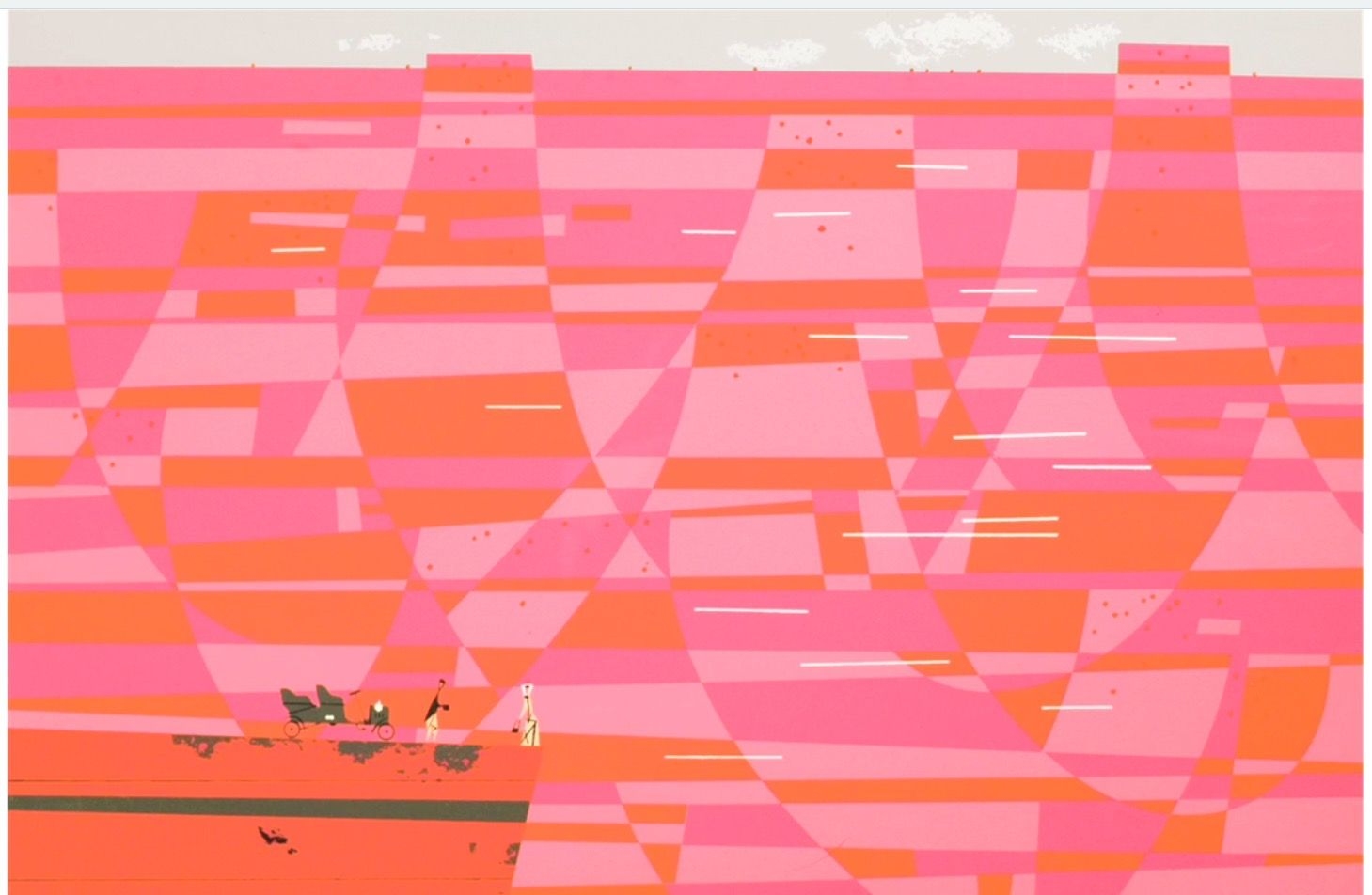
Today is the birthday of American Modernist artist Charley Harper, born August 4, 1922 on a farm in Frenchton, West Virginia. He is best known for his unique self-described “minimal realism” artistic interpretation of American wildlife.
After growing up on the farm, he went to the Art Academy of Cincinnati, where he met his wife, Edie Mckee, on the first day of school. He stayed in Cincinnati, where he eventually started Harper Studios. He has illustrated for a number of books and nature-based organizations including the Cincinnati Zoo and the National Parks Service.
Sierra Range – National Park Poster, 1990 | charleyharperartstudio.com
Broad and High describes a little about Charley Harper’s technique and his illustrations for the book Ohio’s Natural Heritage in this “ARTifacts: Charley Harper” video.
Today is the birthday of Aleksandr Petrov, the Russian animator born July 17, 1957, in the village of Prechistoye. He is known for his unique technique of creating animations from pastel oil paintings on glass, using his fingertips to paint for added texture.
Petrov’s first animation was made in 1988, Marathon, and was a tribute to Mickey Mouse! But his most famous film is his version of Hemingway’s The Old Man and the Sea, made in 1999.
Created slightly after the Soviet era, here is Petrov’s beautiful Russian animation The Old Man and the Sea. It has won a number of awards, including the Academy Award for Best Animated Short Film, and is a wonderful example of the beauty of Petrov’s painted glass technique.
Walt Disney’s Enchanted Tiki Room entrance at Disneyland | Comet Atomic, Jennifer Hall
The first image that comes to mind when anyone mentions Tiki to me, is the famous Walt Disney Enchanted Tiki Room. There are three such rooms. One is located in Disneyland in Anaheim, California, and the other is located at Disneyworld in Orlando, Florida, and the third is located in Tokyo, Japan at the Tokyo Disney Resort.
With the bright colors and exotic birds in the Tiki room, the Room is a tropical paradise. If you want a definition of Tiki, just look around at The Walt Disney Enchanted Tiki Room! Bright aqua, orange, different shades of green, pink, pops of red and lots of exotic birds are all in the Tiki Room to greet guests as they enter.
Walt Disney’s Enchanted Tiki Room Poster | Disney
The first Tiki Room in Disneyland was an animatronic achievement in the industry. The talking birds are all robotics and when they were introduced in 1963, this was incredibly novel. Of course now, in our advancement to graphics and computer technology, the Tiki Room is a still fun tradition. And it has been improved with added technology. Still full of music and color, Disney’s Enchanted Tiki Room offers fun entertainment adults and kids enjoy to this day.
One of the fun features of the Tiki Room are the carved totem poles that represent island gods. These totem poles sporadically spring to life and introduce themselves to people waiting on the patio before the show. Also nearby, are Pineapple Dole Whip from the Tiki Juice Bar, located outside as well.
If you see pineapple, torches, Island totem poles, grass skirts, and bright colors, you are looking at all things Tiki. Exotic food, flavors, and loud music also let you know you are in a Tiki environment. All these characteristics are the amenities Walt Disney designed to the very small detail to give visitors to the park a sample of Tiki culture without having to travel to the islands. The idea was to bring the island worlds to this small room and give someone from say, Kansas, a chance to imagine they are somewhere far away, in Polynesia, Hawaii, or Bali. What a wonderful gift to give to people who maybe will never travel past the North American continent!
Exterior of Walt Disney’s Enchanted Tiki Room at Disneyland | Comet Atomic, Jennifer Hall
By the mid 90s the Enchanted Tiki Room was remodeled and improved. Modern speakers were installed throughout the room and a clear sound was able to ring out from every corner. The instruments were stronger, and so were the talking birds. This added more entertainment and further attraction going into the turn of the century. Kids young and old continue to love the Enchanted Tiki Room.
Lively music and catchy songs people expect to hear from the islands help enhance the Tiki Experience. As visitors sit in the air conditioned Tiki Room, they can’t help but believe they are in the island atmosphere with the lights, sounds and colors.
Whether it’s the bright pink, the aqua shades, the thatched roofs, or the whimsical totem poles, the Tiki style and the Tiki culture are here to stay. In many ways, Walt Disney’s Enchanted Tiki Room introduced millions of people in the 60s and 70s to an island culture and a form of entertainment that has since become a mainland culture, and a current decorating style.
the golden hour sunshine hits the living room just right, in a vintage Eichler with modern style furniture and wide windows | San Rafael, California | JudeAnd
Joseph Eichler was born on this day, June 25, 1900, in New York City. He lived in a Frank Lloyd Wright home in Hillsborough, California for a while, and was so inspired by Wright’s new naturalist designs, that he founded a company that eventually created modern, innovative housing for the Greater San Francisco Bay and Greater Los Angeles areas, as well as a few commissioned homes on the outskirts of New York City. What was particularly interesting about his venture was that he created stylish housing that was affordable for middle class denizens.
His company, Eichler Homes, built over 11,000 homes in twelve California communities and he established an anti-discrimination policy so that no one would be prohibited from buying an Eichler home. He was the only architect to build mid-century modern tract homes for the masses.
Eichler Homes | photo: Ernie Braun, courtesy Eichler Network Online
He utilized the benefits of his environment for his homes. The homes offered clean lines, open courtyards, lots of window spaces to let the California sunshine reign in, and he used local materials like California redwoods to design the interiors. His style was typically referred to as “California modern.”
“I don’t want to be immodest, but I believe we were the first volume builder in California to use many of the things that are now commonplace: sliding glass doors, built-in range and oven, metal cabinets, metal sash, radiant heat in floors.” – Joseph Eichler, American Builder Magazine
The Scarlet Flower (Аленький цветочек, Alenkiy tsvetochek) is a popular Russian folktale based on Sergey Aksakov’s rendition of the classic fairy tale Beauty and the Beast. Similar to the traditional tale, it begins when a merchant father, Stepan Yemelyanovich, asks his three daughters what gifts they would like from his travels. The oldest daughter, Gordeya, wishes for an expensive tiara. The middle daughter, Lyubava, wishes for a magic mirror in which she will always look young. And Nastenka, the youngest, asks for a scarlet flower like the one she saw in her dream.
While on his trip, Stepan finds the first two gifts for his daughters, but cannot find a scarlet flower, so he sets sail for home. However, on his journey back, he gets shipwrecked on a mysterious island where he finds a flower like the one in Nastenka’s dream, and picks it for her. But upon taking it, he learns that the flower belongs to a beast, who allows him to keep it, but tells him to send one of his daughters in return. The father refuses, and the beast gives him a magic teleportation ring and tells him that either his daughter must wear the ring to come back, or the father must return and be killed.
The Scarlet Flower
At the time the Soviet Union was in place, Aksakov’s version of the folk tale was best known. When the writer was young, his housekeeper would tell him stories, and he remembered hearing The Scarlet Flower when he was ill and suffering from insomnia. Later, Aksakov said in a letter to his son, “I am writing a story which in my childhood I knew by heart.”
Director Lev Atamanov brings the story to life in his lovely and delightful 1952 animation. I love this version for the beautiful animation and deep, rich color combinations.
The film was made in Soyuzmultfilm studio with screenplay by Georgiy Grebner and lyrics by Yakov Shvedov. The music was written by Nikolai Budashkin, with chamber singer Victoria Ivanova performing Nastenka’s song “During This Time in a Darling Party.” I like the Russian version with English subtitles best, but couldn’t find a video for it, so instead, here is a short 11 second clip to illustrate the animation.