Moana Brings Tiki to the Young

Moana | Disney Parks Blog

Disney’s Moana brought the world of Tiki and Polynesia to the screen with music, laughter, and tears, to delight both the young and young at heart! The phrase “art imitates real life” holds true with this film. This piece of cinematic art holds true to the Tiki culture, and the stories of the Polynesian people, and the movie is based on actual Polynesian legends.

The real-life voyages of the Malama Honua and the worldwide voyage of Hōkūle‘a is the basis for Moana. Moana’s voyage is set to travel and to see that everyone is connected because of the ocean and that our journey on earth is to help each other. What a beautiful idea!

Hōkūle‘a (“Star of Gladness”) named for a zenith star of Hawaii | hokulea.com

The Polynesian people are known for being peaceful and skilled in the water, among many other things. And unlike some of the stereotype, the movie Moana has shown us the island people are different in many ways. They don’t all wear grass skirts and throw fire. The people of the Pacific Islands have rich histories and traditions.

The first Polynesian Tiki statue dates back to the 13th century and was carved in stone. This originated from the Marquesas Islands. There are more famous statues called the Moai of Easter Island. These are Half man and half god statues and are what we picture in our heads when we think of Tiki statues. These are stocky figures with the arms close to the side. Usually the mouth is open and the eyes are big. There were glimpses of Tiki statues throughout the movie, Moana.

The Polynesian Tiki is a representation of the creator. One who created human beings. The Tiki statues used to be found near sacred places, but now they are sprinkled though out the islands. The Tiki is central to the Polynesian culture. Even today, a Tiki placed outside the home is considered to be a protection for all those inside, and a welcome to all who enter. It is thought to keep bad energies away.

A Polynesian Tiki may be carved from different materials today. Stone is still used, as well as wood, jade, coral, or bone. The carving takes a great deal of patience. Reflective of the Polynesian people, the pace of the carving is not something the craft person finds upsetting. There is a passion and a love for the carving and the creating of something that a person or family is going to love and cherish for perhaps generations. Every Tiki has a different meaning. Some represent strength, love, power, wisdom, wealth, prosperity, health, and others traits.

Moana | Disney

Now that Moana has made its way to the screen and into our homes, we see the characters and Tiki figures also in plastic. But that’s ok. The kids of today are gaining a rich understanding of Polynesian culture, and adults learned some new facts from the movie, Moana. Disney did a wonderful job of bringing the island beauty and culture to life for us to learn about and enjoy.

It is rumored that The Disney Enchanted Tiki Room plans to add Moana to the longstanding Tiki tradition. This would include Hei Hei, Moana’s side-kick rooster, colors, and music from the movie. Even if Moana does not join the Enchanted Tiki Room, the Tiki of Moana is here to stay.

Tiki and the Love of Dance

Hawaiian Men preparing to Dance with Fire in Maui | Deborah Kolb

Yes, even the discount aisle at Target now carries Tiki products. For $1 to $3 this month you can buy everything from Tiki head containers to little planters, signs, and other Tiki décor to complete your party plans or your Tiki collection.

In the midst of this resurgence of the Tiki trend, let’s continue to look back at what brought us to where we are with Tiki. Tiki probably would not have caught on like it did in the 50s without the music and the dances. In this article we will explore the many dances from the early Tiki era.

Different kinds of Hawaiian music created a dancing fad with Hula girls dancing to the music. It wasn’t long before the Hula style dancing was a dance that everyone was doing and a trip to Hawaii had to include a “Luau” complete with Hula dancing. There was also a type of dancing called exotica that went along with the exotica music. The ukulele played a big role in creating the Tiki dancing and music scene.

Photo by Fernando Macias Romo

The original Hula dance is a way of telling stories of war or religious context. Ancient hula was performed before any Western influences with Hawaii and is called Kahiko. This dance is accompanied by chants and traditional instruments. Hula, after the Western “encounters” is called Auana. This means “to drift” or “to wander.” This is where the guitar and the ukulele come in.

There are two forms of Hula dance. One is sitting and one is standing. Some dances involve both forms. Hula dancing involves many motions and is a complex art form. The hand and leg movements symbolize several aspects in nature, such as a tree swaying in the breeze, or the wave of the ocean. They can also represent a feeling or an emotion such as joy or sadness, love or despair.

Many hula dances that were passed down from before the 1800s were considered to be religious performances. They were usually dedicated to honoring a Hawaiian goddess or a god. The ceremonies at the time were held at the hula which was the platform temple. It was the tradition and practice that even a slight error was considered to invalidate the performance. It might even have dire consequences. Dancers who were learning to do such hula, were ritually secluded and under the protection of the goddess Laka during the learning period, so when they made mistakes, they were safe. The ceremonies marked the successful learning of the hula and the end of seclusion.

Hula Dancer on the Beach in Kauai at Sunset | Christian Kieffer

Often a chant accompanied the Hula. The Hawaiian proverb, “O oe ka lua’ ahi o kau mele” translates loosely as “you bear both the good and bad consequences of the poetry you compose. This idea comes from the ancient Hawaiian Hawaiian belief that language possessed mana or power gained form a spiritual source when delivered through a chant. The chant was delivered reverently and was an important part of the ritual of dance and of the Hawaiian society.

A law passed in Hawaii in 1896, shortly after the American overthrow of the Hawaiian kingdom, that banned the use of the native language of in Hawaiian in schools. All Hawaiian culture in general was usurped and this contributed to a mass decline of the Hawaiian language. As Christianity spread the changing became viewed as a pagan practice. Because of the Tiki craze in the 60s, the Hula and the chanting made a comeback as well as the Hawaiian identity. Now the Hawaiian State Department of Education sponsors Hawaiian language immersion schools as well as major hula competitions every year.

Be on the Lookout for this Treat: Hawaiian Tiki Trucks!

DA POKE’ WAGON | Peggy

Last Friday night we had first Friday in Kansas City. And I had the best food from a food truck called, DA POKE’ WAGON. And you guessed it. It was Hawaiian food! It was a Poke’ (pronounced Poh-keh), bowl of basically Hawaii’s favorite food, poke’. According to the food truck’s motto, for good reason; it is healthy, delicious, and totally unique. Poke’ is a simply a way of preparing raw fish. However, I opted for the shrimp in my bowl, because it was cooked.

At the base of the dish is brown or white rice. You could also opt for chopped salad. Then the protein comes next. The choices are marinated tuna, naked tuna, marinated salmon, naked salmon, marinated shrimp, naked shrimp, marinated tofu, and naked tofu. Then you can decide if you want the signature Hawaiian bowl or the signature Midwest bowl. After that you have the options to had “da heat.” This includes Jalapeno edamame, seaweed salad crunch, or tobiko chili aioli. After those delights, you have toppings to add. Some include, cucumbers, pineapple, wasabi, sweet onion, edamame, avocado and an assortment of sauces.

The line outside this food truck was the longest I have ever seen from any food truck. And the food was amazing! I have never tasted a meal quite like it and would definitely eat this food again and again. So I decided to do some research on my own and found that Tiki food trucks are on the rise. And why not? Tiki restaurants are everywhere, so it only makes sense for Tiki food trucks to follow.

DA POKE’ WAGON | Peggy

A food truck called Hula Girl, brings the Aloha spirit to the DC area in a decked out woody truck that serves grilled Hawaiian teriyaki, plate lunches, salads and sandwiches.  They launched their truck in 2011 in Franklin Square Park.

There are even Tiki food trucks in Hawaii. They market by saying, “Ditch the Resort Food and Eat at South Maui Food Trucks.” One of the popular food trucks in Maui is called Three’s Food Truck. They are located in the Kihel Market Place across from Kalama Park in Kihei, Maui, Hawaii. Another food truck located on the Islands is called Jawz Fish Tacos. Since 1998, Jawz has been catering to boogie boarding locals and beach going tourists in Makena. Their fish tacos have become famous and have led them to become a favorite stop for beach snacks and lunches.

If you stumble on one of these trucks like I did, brave the long lines because the food is worth it. I have to say, this was the best meal I have had in a long time. If this is Hawaiian food, I am all in. There are Hawaiian food recipes available online that are healthy and delicious. The initial purchase of the ingredients is a little expensive such as the sauces and spices, but once you have those, the Hawaiian dishes are a delight. And don’t forget to catch a Tiki Food truck if you get a chance! Look for the bright colors of teal, brown, pink, purple, and greens. Chances are this truck has Hawaiian food.

If you are preparing at home, a simple recipe includes: your fish cut into cubes, rice or noodles, a sauce, slightly salty marinade, or other favorite dressings, like a ponzu sauce, add vegetables or fruit, such as pineapple, avocado, mango, edamame and also onion, cucumber, seaweed, radishes, or anything else you enjoy. Lastly add a topping. Toasted sesame seeds, chopped macadamia nuts, and anything else to add a crunchy effect. Stir together and you have a healthy homemade poke’ dish!

Discovering Route 66: From Tulsa to Arcadia

Rock Cafe Sign in Stroud, Oklahoma

Last weekend my family and I took a day to explore Route 66 along Tulsa to Arcadia. Our first stop was for lunch and a little sightseeing in Stroud, Oklahoma. There were a few places that we found interesting, but finally decided on lunch at the Rock Café, a well known historic Route 66 landmark that was an inspiration for the movie Cars, and it was also featured in Southern LivingGourmet Magazine, and the Guy Fieri show Diners, Drive-Ins & Dives.

Rock Café in Stroud, Oklahoma

It was cold and sprinkling outside, but warm and very hospitable inside, and decorated to the hilt with Route 66 and cars memorabilia. Along with the usual diner fare of burgers and sandwiches, patrons can also get southern favorites like fried green tomatoes and Indian tacos, as well as a delicious savory jägerschnitzel & spätzle dish with bacon mushroom gravy that was featured on Diners, which is what I had.

Rock Café in Stroud, Oklahoma

Stroud is the perfect example of small town Americana, modest yet dotted with these colorful Route 66 icons, which makes them stand out even more, and the Rock Café sign and building are no exceptions.

Skyliner Motel

After lunch, we stopped by another Route 66 landmark in Stroud, possibly best known for its wonderful vintage sign design, the Skyliner Motel.

Front View of the Round Barn

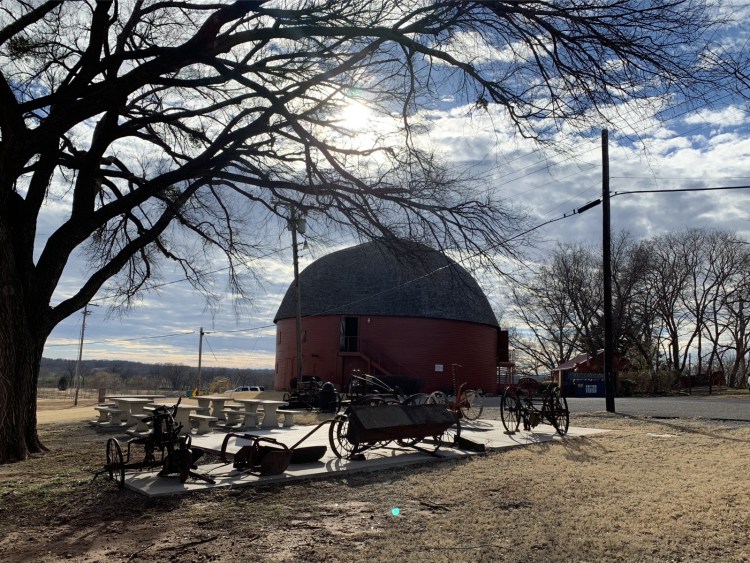
The next place on our list was the Round Barn in Arcadia, Oklahoma. Built in 1898, the barn is famous for its unusual round top, which was designed by William H. Odor, who had the idea to soak oak boards until they were bendable to create a round building.

Back View of the Round Barn

When we walked inside, we were greeted by an extremely friendly older gentleman who worked as a guide and was more than eager to tell us everything we would want to know about the barn, including the fact that restoration efforts over the years used much of the original wood.

Round Barn Ceiling

We climbed up to see the top, which was spacious and echo-y, and had a central area for visitors to stand in for maximum acoustic effect. For those who have visited Tulsa’s Center of the Universe, it sounds much like that. Every second Sunday, visitors can hear live music in the Round Barn, and it is open from 10-5 daily.

Round Barn Top

Pops 66 Soda Ranch, the Arcadia restaurant and gas station famous for having hundreds of kinds of soda, was only a few minutes from the Round Barn, and our last stop on this adventure.

Pops Entrance

The building has won several architectural awards for its beautiful modern design by Elliott + Associates Architects. The glass walls of Pops are lined with different kinds of soda, and they also have shelves and coolers full of more choices! We each picked out four flavors – mine were watermelon, caramel apple, chocolate, and some kind of interesting looking Hawaiian soda.

Soda Lined Walls of Pops

Outside of Pops is a 66-foot tall soda bottle, which is lit up with a rainbow of colors at night. Here is a view from our overcast afternoon.

Pops

On the way home, we drove through Chandler and spotted a few more cool 66 signs, including an old Phillips 66 sign and a 66 Bowl sign that was moved from Oklahoma City and recently resurfaced in Chandler at the location of a planned bowling alley.

Phillips 66 | Route 66
66 Bowl in Chandler

Discovering Route 66: Tulsa’s Mother Road Market

Mother Road Market Sign on Route 66

I always say that there are two things that I like best about living in Tulsa: the friendly people and the architecture, and the former proved to be true once more when my family and I took a walk through the Mother Road Market this weekend and were greeted by the friendliest of vendors!

When you walk into Mother Road, you can tell that it’s not just about the local food and shops, although the food alone would be enough to shout about, but it’s also about the culture of Route 66, celebrated with various kinds of artwork. When you walk in through the front, if you’re lucky enough to find front parking, you are welcomed with a larger-than-life Route 66 mural created by local artists Yatika Starr Fields and Janet Fadler Davie.

Route 66 Mural

Once inside, visitors have a number of interesting vendors to choose from, and when you stroll through and arrive at the opposite side of the building, you can enjoy a cheery wall painting depicting some key Route 66 destinations.

Route 66 Wall Painting

When we were there, there were also First Nations musicians and dancers whose sounds and movements filled the entire marketplace and really brought the place to life!

First Nations Dancers

The Market has a wide variety of local food offerings, including everything from a bakery to an ice cream stand to Tulsa’s beloved Andolini’s Pizza to some newer and very intriguing vendors like Umami Fries and Chicken and the Wolf.

Umami Fries

My daughter, Natasha, and I love Asian flavors so we had to try the Thai Tacos and Gogi Pork Fries from Umami Fries. We got both items for just over $23, which was worth it for the quality and the generous portions. Both items were incredibly flavorful and delicious and we were very happy with our choices!

Gogi Pork Fries (Left) and Thai Tacos (Right)

My daughter’s boyfriend, Austin, got the “Nashville” chicken sandwich from Chicken and the Wolf, which was a hearty piece of fried chicken served on a toasted bun, and topped with a special sauce. Be warned, he ordered it on the mild side of the scale and it was quite hot. They did tell us that their spice levels were higher than usual, and they weren’t kidding! The sandwich was served with their homemade coleslaw on the side.

Chicken and the Wolf

I was very interested in their entrée salad that comes with an amazing-sounding lemon dill buttermilk dressing, but was too full from Umami Fries to try anything else today.

The Nashville Chicken Sandwich

Oh, and did you notice the Shasta Tiki Punch in the photo? This was exciting. It’s not just anywhere that you can get Tiki Punch!

Outside, when the weather is nice you can sit on their lovely patio and even enjoy a game of mini golf, which is comprised of super cute renditions of notable Route 66 stops.

Mini Blue Whale at the Mother Road Patio Mini Golf Course

After visiting the Mother Road Market, we knew that we needed to take on more Route 66 adventures, and decided to make this an ongoing project. So please stay tuned for more Route 66 stops, and send us any suggestions of Route 66 places to visit in the comment box, too!

End of the Road – Mini Santa Monica Pier at the Mother Road Patio Mini Golf Course

Downtown Tulsa’s Modern Architecture Tour

Tulsa’s Holmes Organization/Warren Petroleum building (International Plaza, 1957) | Jennifer Hall

This weekend my friends and I enjoyed a rainy yet amazing tour of downtown Tulsa’s Modern architecture guided by the Tulsa Foundation for Architecture.  I always tell people that two of my favorite things about Tulsa are the friendly people and the architecture, and many of my favorite T-town buildings were covered in the tour.

When downtown Tulsa was forming, many local oil companies were booming from profits from automobile sales as well as profits from World Wars I and II, so they were able to invest in cutting edge architectural designs.  That explains why many of these buildings were designed for the oil industry, and some of them still house oil companies today.

One of the first stops on the tour was the Blue Cross Blue Shield Building (1954).  The building was first designed by the architectural firm Koberling and Brandborg AIA and constructed in 1954. Originally, the building was only three stories high, but the need for more office space, including making room for the first computers, gave a need for more stories.  So in 1969, nine additional stories were designed by architect Joseph R. Koberling and engineer W. C. Roads and added to the structure.

The Blue Cross Building also features an Art Deco frieze above the entrance.  Tulsa is perhaps most famous for its Art Deco architecture, but in many of the city’s buildings, Art Deco and Modern décor and design overlap each other.

Holmes Organisation/Warren Petroleum (International Plaza, 1957)

Warren Petroleum (International Plaza, 1957) was designed by Chicago’s Sears Tower, or Willis Tower, architect Bruce Graham of Skidmore, Owings & Merrill LLP (SOM), and was one of the most interesting legs of TFA’s Tulsa Modern architecture tour.  In its heyday it was filled with the best in modern furniture, including Barcelona chairs and Eames office furniture, during an era when many businesses felt that their office building’s architecture and style were a direct reflection of their awareness of the needs of the times.

You can see a bit of one of the environmental functional design features in the photos above, how the Warren Petroleum/International Plaza Building used double-glass-paned windows to absorb the heat of the sun and help to keep the interior cool naturally.  The concept was inspired by the Swiss-French modern architect Le Corbusier’s “neutralizing wall,” which allows air to circulate between panes of glass.

Kewanee Oil (1953)

Originally the Kewanee Oil Building (1953), the office located at 14th and Boulder showcases another Art Deco frieze similar to the one displayed in the Blue Cross building, and is one of Tulsa’s Modern buildings exhibiting Bauhaus influences, designed with clean lines and lots of glass.

Skelly Building/Boulder Towers (1960) | Jennifer Hall

Here we see Tulsa’s well known Skelly Building/Boulder Towers Building (1960).  This structure was originally built for Skelly Oil Company and Cities Service.  With changes of hands over the years, the building has also been known as the Getty Oil Co. Building (1980) and later on, the Texaco Building.

Another view of the Skelly Building/Boulder Towers (1960) | Jennifer Hall

Boulder Towers is located on the northeast corner of 15th Street and Boulder Avenue.

Liberty Towers (1965)

Caddy-corner to Boulder Towers is the Liberty Towers Building (1965), which was designed by the architectural firm Kelley-Marshall Architects, known for their Modern high rises.

University Club Tower (1967)

The University Club Tower (1967), popularly dubbed the “Syringe,” is a well known Tulsa landmark because of its unique shape.

Murphy Oil/Langdon Publishing (1960)

The Murphy Oil/Langdon Publishing Building (1960) also showcases clean lines in its design, as well as a cozy alcove of an entrance.

Various Modern structures are visible from the Gallagher/Bryce Building on Main near 14th, a stop which was in the final part of TFA’s Tulsa Modern architecture tour.

From this site, we could see the Boston Avenue United Methodist Church from afar, one of Tulsa’s most famous buildings which was designed by Adah Robinson and one of my favorite architects, Bruce Goff.  On a side note, Bruce Goff also designed the Bavinger House constructed from spiraling sandstone, an architectural gem which was set in Norman, Oklahoma, but unfortunately the house was destroyed by a storm.  The Bavinger House is one of the most interestingly designed structures I have ever seen.

Here is a close-up of Boston Ave. UMC that I had taken previously.

Boston Avenue Methodist Church | Jennifer Hall

The Boston Ave. UMC tower is a great example of Art Deco design.

That was my rainy day view of downtown Tulsa’s Modern architecture.  As much as I love rainy weather, one day I hope to provide another sunnier perspective of all of these places!

If you’re interested in seeing more of Tulsa’s architectural designs, the Tulsa Foundation for Architecture gives tours every second Saturday; you can find tour information and more on the TFA site.