Dancer and actor Leslie Caron was born on July 1, 1931, in the commune of Boulogne-sur-Seine in the western suburbs of Paris, France. She brought some of the most endearing characters in the history of film to life, including Lise Bouvier in An American in Paris, Lili Daurier in Lili, Ella in The Glass Slipper, Gigi and Fanny from the eponymous classics, and Catherine from Father Goose.
That’s only to name a few of her great roles, and these days she still keeps busy restoring historical French buildings and converting them into inns. She is also still acting as Countess Mavrodaki in the TV show The Durrells in Corfu, along with her grandson Ben Hall, who plays Donald, and works with more family on the show, too. She has said that her happiest times were those spent with her family.
When I was about twelve years old, I first started catching her movies on cable television. Her charm, cute style (especially that pixie cut à la The Glass Slipper era), and graceful dancing won me over immediately. Here she is in the 1955 classic, The Glass Slipper.
Radio Martiko recently re-released two solid surf rock gems from the ’60’s from French Canada’s Les Talismans and Les Jaguars. They are “L’interplanetaire” and “Guitare Jet,” respectively.
They’re available on Surf Québécois, available from Radio Martiko’s bandcamp.
Ever since I was a little girl, I have been fascinated…no I LOVED those little mini umbrellas that go on top of fancy drinks. Not that I had fancy drinks. But one time I went to a little birthday party at a neighbor’s house and the mom and grandma put little mini umbrellas on top of our ice cream sodas. I was amazed! I had never seen such a thing. I was four years old. I’ll never forget it.
Don the Beachcomber
The mini umbrellas have Tiki roots. Well, Don the Beachcomber roots. When Don the Beachcomber traveled the world, he brought back his loves to California; exotic locales and booze. He was quoted as saying, “If you cannot go to paradise, I will bring it to you.”
His cocktails had all kinds of decorations, but why the umbrella? As it turns out these little colorful parasols may have served more of a purpose than just to attract the ladies to the Tiki bars. After all, what purpose does an umbrella serve in the sun? To keep the user cool and to offer shade. Now why wouldn’t that work for a drink as well?
As it turns out, drinks don’t actually sit around long enough to get warm, but the original idea of the umbrella did serve a double purpose. It was shade for the drink and a colorful pop from the umbrella!
Sippin’ Safari by Jeff “Beachbum” Berry
Who Makes Those Umbrellas and Who Really First Used the Mini Umbrella?
They are made in China. And, according to historian, Jeff Berry, who has written six books about the Tiki culture, the first person to actually use these little umbrellas was Harry Yee at the Hilton Waikiki. Mr. Yee first used a sugar cane to garnish his cocktails and then when that wasn’t working out, he tried an orchid. However, it was his use of the mini umbrella that became the signature of the drink. People even called the drinks, “umbrella drinks.”
In fact, the first drink to get an umbrella was in 1959. So, back to my story of the birthday party when I was four. That was in 1962. Thinking back this little girl’s mom and grandma were really on the cutting edge of ice cream soda toppers! Wow! I may have been among the first four-year old’s in the United States to enjoy those mini umbrellas. And I love them still!
Jeff “Beachbum” Berry
We cannot talk about the little umbrellas without progressing into some of the wackiest new toppers for drinks and yes, ice cream sodas today. Starting out is the famous flamingo, then comes the mustache straw, the bamboo knot, the plastic sword, the pirate flag, a sparkly pom-pom, clowns (if you like clowns), LED animals, and plastic monkeys, All of these are available on Amazon or other websites that sell food products.
It’s fun to decorate for any types of drinks. I think it may be time to introduce my grandkids to the wonderful mini umbrellas. There is nothing like a brightly colored umbrella in an ice cream soda or a root beer float. Maybe it’s also time for a plastic monkey or a sparkly pom-pom?
Walt Disney’s Enchanted Tiki Room | Comet Atomic, Jennifer Hall
“Buenos días, señorita. My siestas are getting shorter and shorter.”
-José Tiki
On June 23rd, 1963, Disney’s Enchanted Tiki Room was opened to the public at Disney parks. It was an amazing event that featured the first Audio-Animatronic show. The new technology was brought about by Walt Disney’s love of animation, and his desire to bring the joy of animation into the real world.
Enchanted Tiki Room Concept Art | Disney
The attraction opened at a time when tiki culture was flourishing, with Polynesian-themed bars, tiki art exhibits, and Hawaiian lounge music popping up all around the U.S. The excitement may have started almost two decades earlier, when the first known major exhibit representing island culture appeared in 1946, with the New York Museum of Modern Art showing “Arts of the South Seas.” It received a full five-page feature in LIFE magazine, bringing tiki culture into America’s spotlight (1).
By 1962, tiki culture was growing along the Pacific coast, particularly in Californian cities like Palm Springs, which was also an early adopter of modern American architecture movements, and as the two often go hand in hand, the city had fully embraced tiki culture as well. So when Disney opened the Enchanted Tiki Room in California’s Disneyland (as well as in Disney World) a year later, it was excellent timing and placement to bring the tiki attraction to large audiences.
This is a behind-the-scenes look at the 2011 re-opening of the Tiki Room.
And here’s a video that Disney re-released on the 50th anniversary of the Enchanted Tiki Room, where Disney imagineer Rolly Crump gives us some insight into how the attraction was created.
The Tonga Room lagoon, Tonga Room and Hurricane Bar, San Francisco | Cmglee
Californians can look forward to one of the most iconic bars, The Tonga Room & Hurricane Bar in San Francisco, reopening July 9. The Tonga Room is famous for its rich tropical décor, Polynesian-fusion cuisine, and the occasional tropical rainstorm, complete with thunder and lightning!
The Tonga Room will reopen on Fridays and Saturdays between 5 and 11 p.m. with dinner served from 5 to 10 pm. It is located at 950 Mason Street, San Francisco, CA 94108.
In this caper, Regina Lampert (Audrey Hepburn) and Peter Joshua (Cary Grant) become intertwined in mystery and romance after meeting each other on a ski holiday in the French Alps. After returning to Paris, Lampert learns that her husband has been murdered, and that he was involved in a theft. Now Regina is being pursued by three of the remaining criminals who believe that she has the $250,000 that was stolen, and in a strange twist, Peter shows up in Paris and becomes involved in the situation, so Regina and Peter set out to unravel the mystery. In the mean time, Regina is falling for Peter while also questioning his suspicious behavior. The story that ensues is a whirl of love, suspense, and false identities.
This is a quintessential classic that has all of the elements of great film, from the wardrobe to the writing to the musical score by Henry Mancini. It glows with quality acting from three twentieth century icons, Cary Grant, Audrey Hepburn, and Walter Matthau. Stanley Donen, best known for his popular upbeat musicals Singin’ in the Rain and Funny Face, took a delightfully dark detour in the making of this film. The Charade screenplay, written by Peter Stone, is an adaptation of the book by Peter Stone.
Charade Poster
Charade is splendent with brilliant wardrobes and Paris scenery, yet shadowed by the Hitchcock-esque filming, giving it a really unique feel. In fact, the film is often referred to as “the best movie that Hitchcock never made.” Audrey Hepburn’s character sparkles with quirkiness and strength even though she is fraught with worry, while Cary Grant exudes coolness and mystery throughout the film, and both of the main characters bring a touch of humor to the movie. Filled with wit, charm, and 60’s style, this is one not to miss.
The opening title, with its colorful animation designed by Maurice Binder and the music of Henry Mancini, was enough to draw me in.
In this eerie animation, a nuclear bomb hits a California town, and only one house is left standing, an automated house with robots. The people did not survive, but the robots who cook, clean, and take care of everything continue with their daily routines long after the humans are gone. Finally, the robots are also destroyed, by a fire.
In a haunting final scene, a bird comes along and plays a song on a record player in the remains of the house, and a narrator reads “There Will Come Soft Rains” by Sara Teasdale, which was written as a reference to World War I. In the original short story “There Will Come Soft Rains” by Ray Bradbury, we know that Sara Teasdale was “a favorite” poet of one of the homeowners, Mrs. McClellan.
There Will Come Soft Rains Poster
“There Will Come Soft Rains”
There will come soft rains and the smell of the ground, And swallows circling with their shimmering sound;
And frogs in the pools singing at night, And wild plum-trees in tremulous white;
Robins will wear their feathery fire Whistling their whims on a low fence-wire;
And not one will know of the war, not one Will care at last when it is done.
Not one would mind, neither bird nor tree If mankind perished utterly;
And Spring herself, when she woke at dawn, Would scarcely know that we were gone.
The Ray Bradbury story “There Will Come Soft Rains” was first published in the May 6, 1950 issue of Collier’s, and in The Martian Chronicles later the same year. The film was directed by Tulyahodzhayev Nazim, and it won the “Golden Dove” Award at the Leipzig International Festival for Documentary and Animated Films in 1984.
Here is “There Will Come Soft Rains.” Click CC for subs.
This Forest Park, Ohio home features beautiful mid-century modern accents, vaulted ceilings, lots of natural light, and abundant space, as well as a fantastic tiki bar in the basement.
Den | 1116 Inner Circle
I love this beautiful outdoor walkway with a cool view of the lush greenery surrounding the home.
Outdoor Walkway | 1116 Inner Circle
The 3,996 square foot home was build in 1971 and is located at 1116 Inner Circle, Forest Park, OH 45240. It is currently on sale for $410,000 for a lucky buyer. Photos of the home are eye candy for the rest of us.
This Thursday marks the new moon and the first solar eclipse of 2021, and to usher in this unique combination of celestial events, I have mix of exotica and relaxed moon remixes to sit back and enjoy this Tiki Tuesday. Here’s a summer-y “Tiki Moon Mix” via Soundcloud.
Tiki Moon 🌕 Tracklist
1) The Dixie Cups – “Iko Iko” 2) Kava Kon – “moon mist” 3) rxn – “moon” 4) The Police – “Walking On The Moon” (Millesim Remix) 5) doc shivers – “Fruit of Dreams” 6) Anika – “Love Buzz” (Shocking Blue) 7) George Auric – “O Willow Waly” (The Innocents) 8) The Tikiyaki Orchestra – “Polynesian Village Love Theme” 9) Karen O – “The Moon Song” 10) dontcry – “Moon”
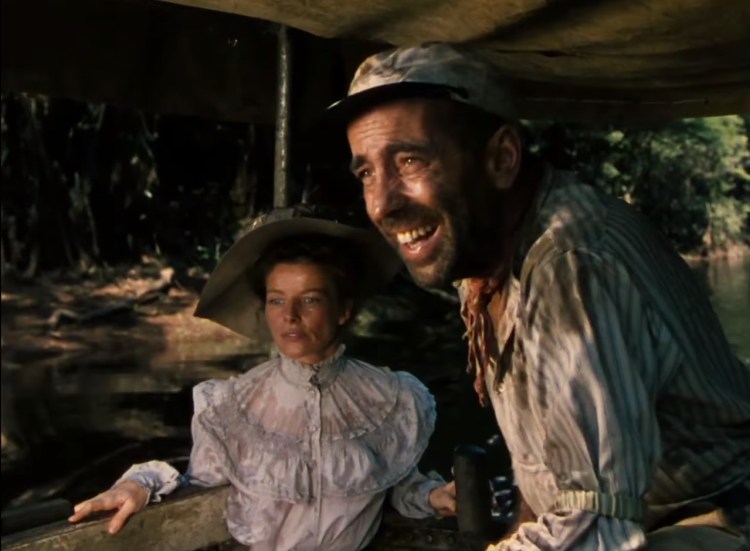
Recommended for its entertainment value as well as its cultural significance, The African Queen is delightful. When puritanical missionary Rose Sayer (played by Katharine Hepburn) and gin-loving, freewheeling riverboat captain Charlie Allnut (Humphrey Bogart) take a wild river ride together, they find a surprising connection to each other. Their journey isn’t easy, though; the film is set in the Congo during WWI, where the duo has to overcome the perils of the river and of the Germans.
The story begins in the village of Kungdu in German East Africa, where Samuel Sayer and his sister Rose serve as British Methodist missionaries at the beginning of the WWI in August of 1914. At first, the missionaries are unamused by the gruff mechanic Charlie Allnut, who delivers their mail and supplies via the African Queen steamboat. Things change swiftly when war breaks out between Britain and Germany, though; chaos ensues as German troops burn the village and push for the occupants to fight for the Germans. Protesting their actions, Rose’s brother Samuel is struck by a German, after which he contracts a fever and dies. Charlie steps up and helps Rose bury her brother, and the two have little choice but to escape on the Africa Queen. During their voyage, they hatch a plan to sink a German warship named Louisa, too.
The African Queen (1951)
The African Queen is an archetypal tale of duality between two headstrong characters who clash at first, but evolve with the story, becoming more open to each other, and finding betterment in doing so. During their journey, Charlie learns to clean up his habits and to allow someone else to contribute to the decision-making, and Rose relaxes her stiffness and eventually gives into her emotions for Charlie. Watching the two go from quarreling travel mates to developing a magnetic attraction for each other is a treat, and their relationship is mixed with great humor as well as depth. Although I have not read it, many agree that the C.S. Forester novel does not really contain the humorous aspect that the movie adopted, and reportedly, the two main actors were already funny together so director John Huston encouraged their witty improvisations.
The developing chemistry between Rose and Charlie is surprisingly magical, and as intense as the scenery, which is also mesmerizing. Filmed in the Congo, one really unique aspect of the film is that the majority of it takes place on the steamer, relying heavily on the dialogue rather than on effects or distractions, as a well-crafted play would. And when the effects do come into play, they are believable.
The African Queen was directed by John Huston, who also worked with Humphrey Bogart on the film, The Treasure of the Sierra Madre. James Agee wrote the screenplay adaptation for The African Queen based on the 1935 novel by C.S. Forester.