
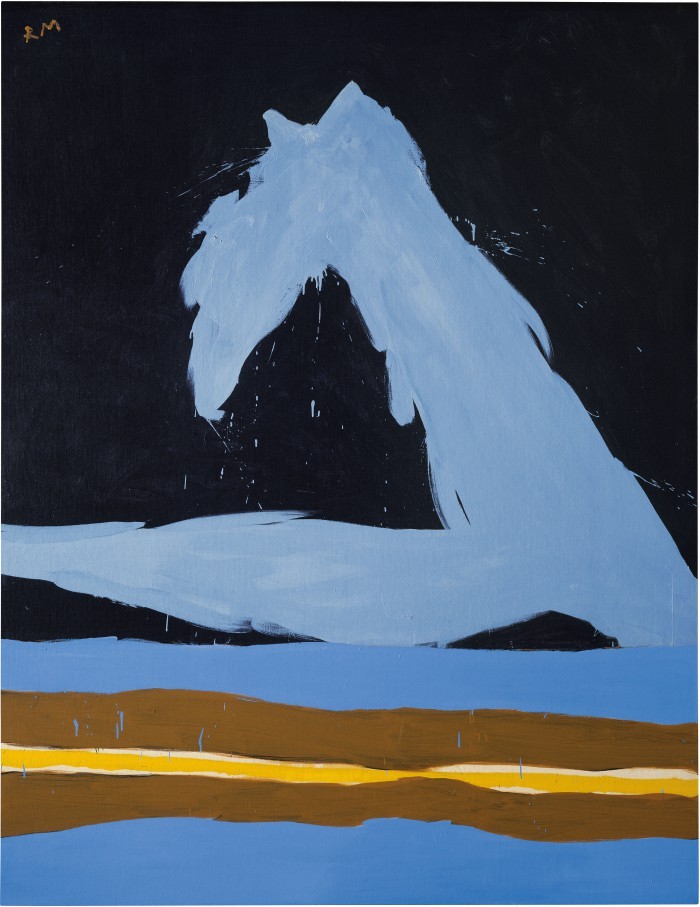
Robert Motherwell could make a painting feel monumental with remarkably little. A few enormous black forms against white might evoke mourning, imprisonment, architecture, bodies, or a procession moving across the canvas. A torn piece of cigarette packaging could become the center of a collage. A charcoal rectangle floating inside a field of ochre could open an entirely new direction that occupied him for years.
His art was often spontaneous, but Motherwell himself was anything but anti-intellectual. He read philosophy, literature, poetry, political history, and modernist theory with an intensity unusual even within the famously argumentative world of Abstract Expressionism. He wrote about art, edited important texts by European modernists, taught younger artists, lectured widely, and helped give the emerging New York School an intellectual vocabulary through which it could understand itself.
Born in Aberdeen, Washington, on January 24, 1915, Motherwell became one of the youngest major figures associated with the first generation of Abstract Expressionism. His contemporaries included Jackson Pollock, Mark Rothko, Willem de Kooning, Barnett Newman, William Baziotes, and Clyfford Still, yet his path into painting was strikingly different. Before committing himself fully to art, Motherwell had studied philosophy and literature at Stanford, pursued graduate philosophy at Harvard, spent time in Paris, and studied art history with Meyer Schapiro at Columbia University.
That background never disappeared. Motherwell could produce paintings through instinctive gestures and automatic drawing while simultaneously thinking about history, politics, literature, death, freedom, and the philosophical meaning of modern art.
For him, intellect and spontaneity were not enemies.
The most interesting paintings needed both.
🌲 From Washington to California
Motherwell was born in Aberdeen, Washington, but grew up largely on the West Coast. His family eventually settled in California, where the young Motherwell developed interests in art, literature, and intellectual life long before he knew exactly how those interests would fit together.
He also experienced chronic asthma, which affected his childhood and later resulted in his being classified as medically unfit for military service during World War II. The physical limitation did not prevent him from drawing and painting, and his family recognized his artistic interests early enough for him to receive instruction while still young.
Yet becoming a professional artist was not initially the obvious path. Motherwell came from a family that expected serious academic achievement, and his education moved first through universities rather than an art academy.
That distinction would shape everything that followed.
📚 Philosophy Before Painting
Motherwell entered Stanford University and studied philosophy and literature, earning his bachelor’s degree in 1937. He then went to Harvard for graduate study in philosophy.
The subjects suited him.
Motherwell was interested not simply in what things looked like but in what they meant, how people constructed knowledge, and how art might express experiences that ordinary language could not adequately contain.
His philosophical education later contributed to his reputation as the intellectual of Abstract Expressionism. The label sometimes risks making him sound more analytical than visual, but Motherwell never treated painting as philosophy translated into images.
Paint had its own logic.
A color could communicate something no philosophical argument could.
A torn piece of paper could create a relationship that words might destroy by explaining too precisely.
The ideas mattered because they sharpened his attention.
The painting still had to live independently.
🇫🇷 Paris
Motherwell spent the 1938–39 academic year in France, officially working toward his graduate studies but increasingly drawn toward painting.
Paris still represented the historical center of modern art. Cubism, Surrealism, abstraction, Dada, Fauvism, and countless other artistic revolutions had unfolded there during the preceding decades. Picasso, Matisse, Miró, Braque, Léger, and other artists had transformed what painting could be.
For an intellectually curious young American, the experience strengthened Motherwell’s conviction that modern art was not simply one style among many.
It represented a new way of confronting contemporary experience.
Europe also gave him direct contact with a culture that would remain central to his thinking even after New York replaced Paris as the perceived center of avant-garde art.
Motherwell’s later career continually connected these two worlds.
European modernism gave him history.
New York gave him his generation.
🏙️ New York & Meyer Schapiro
In 1940, Motherwell moved to New York and entered Columbia University’s graduate program in art history and archaeology. There he studied with the influential historian Meyer Schapiro.
Schapiro quickly recognized that Motherwell’s deepest commitment was not academic art history.
It was making art.
Rather than pushing him away from that impulse, Schapiro encouraged it. Through Schapiro and other connections, Motherwell entered the world of European artists who had fled war and fascism and were living temporarily or permanently in the United States.
This was an extraordinary education.
New York during the early 1940s brought together young American painters searching for a new direction and European modernists carrying firsthand knowledge of Surrealism, abstraction, Cubism, and the prewar avant-garde.
Motherwell stood almost exactly at the intersection.
🌀 Discovering Surrealist Automatism
One of the most important ideas Motherwell encountered was psychic automatism, the Surrealist practice of creating without fully controlling every conscious decision.
Through figures including Roberto Matta and Kurt Seligmann, Motherwell learned methods intended to bypass habitual thinking and allow unexpected forms to emerge.
The idea appealed to him immediately.
This might seem surprising for someone with such an academic mind.
In fact, it made perfect sense.
Motherwell understood that consciousness could become restrictive. Education gives artists knowledge, but knowledge also creates habits. Automatism provided a method for escaping those habits long enough to discover something unexpected.
A line could begin before the artist knew where it was going.
A brushstroke could create the next decision.
Accident could become structure.
The unconscious could participate.
Motherwell never treated this as mindless spontaneity. Once unexpected forms appeared, judgment returned.
The artist discovered and edited simultaneously.
🎨 Choosing to Become an Artist
By 1941, Motherwell made the decisive choice to abandon his academic path and pursue painting professionally.
His family was not entirely enthusiastic.
Painting offered no guaranteed career, and Motherwell had already invested years in prestigious academic study. Yet remaining a scholar increasingly seemed like the wrong life.
That year he traveled to Mexico with Roberto Matta, an experience that became another important turning point.
Mexico provided color, landscape, political history, and visual encounters very different from the academic world he had just left.
It also brought Motherwell closer to an international community of modern artists.
By the time he returned to New York, painting was no longer a side interest.
It was the center.
🇲🇽 Mexico
Motherwell’s Mexican experience entered his early work directly.
Pieces such as The Mexican Sketchbook, La Belle Mexicaine, and Pancho Villa, Dead and Alive demonstrate how quickly historical, political, and personal material became intertwined.
Pancho Villa, Dead and Alive from 1943 is particularly significant because it combines painting with collage. Printed and painted papers, wood veneer, gouache, oil, and ink come together in a work that refuses the traditional separation between drawing, painting, and pasted material.
Motherwell had found a medium perfectly suited to his mind.
Collage allows thought to proceed through association.
A piece of paper already contains a history.
A printed fragment arrives with meaning attached.
Tear it.
Rotate it.
Place it beside another color.
Suddenly something entirely new appears.
✂️ Collage Becomes Essential
Motherwell became one of the great modern practitioners of collage.
This aspect of his career can sometimes be overshadowed by the enormous black-and-white Elegies, but collage was never secondary for him.
The medium appealed because it combined chance and decision.
A painter can mix nearly any color desired.
A collagist encounters limits.
The available paper already has a color, texture, printed word, tear, fold, or stain.
The artist must respond to what exists.
Motherwell loved this dialogue.
Commercial packaging, printed fragments, colored paper, torn edges, labels, and bits of everyday visual culture entered compositions beside paint and charcoal.
The ordinary world became part of abstraction.
📰 The Material Has a Previous Life
A torn wrapper in a Motherwell collage never becomes completely anonymous.
It belonged to something before entering the artwork.
That previous identity remains faintly present.
A French cigarette package may carry typography and associations with cafés, travel, smoking, or memory. A piece of newspaper arrives with fragments of language. A ticket, label, or printed pattern contains evidence of ordinary life.
Motherwell did not need to illustrate those associations literally.
The material carried them automatically.
This gives his collages an unusual emotional density.
They are abstract.
They are also made from pieces of the world.
🧑🎨 Peggy Guggenheim & Art of This Century
Motherwell’s emergence coincided with one of the most important gallery experiments in wartime New York.
Peggy Guggenheim opened Art of This Century in 1942, creating a space where European modernists and younger American artists could appear within the same cultural environment.
Motherwell participated in exhibitions there alongside figures including Jackson Pollock and William Baziotes. Guggenheim offered him a solo exhibition in 1944, one of the milestones that helped establish him within the new American avant-garde.
The importance of these connections is difficult to overstate.
Abstract Expressionism did not suddenly appear fully formed after World War II.
It developed through conversations among painters, critics, European émigrés, dealers, poets, collectors, and museums.
Motherwell was unusually well positioned within those networks.
He could speak the language of Surrealism and European modernism while helping younger American artists move somewhere else.
🗽 The New York School
The group eventually called the New York School was never one unified style.
Jackson Pollock’s poured paintings looked nothing like Mark Rothko’s floating fields of color.
Willem de Kooning moved continually between abstraction and the figure.
Barnett Newman created vast expanses interrupted by narrow verticals.
Franz Kline developed dramatic black-and-white structures.
Motherwell himself moved between automatic drawing, collage, sweeping abstraction, austere rectangles, prints, and monumental black forms.
What connected them was not appearance.
It was ambition.
These artists believed painting could confront modern experience at enormous emotional and physical scale.
The canvas no longer needed to function like a window looking onto another world.
The painting itself could become the event.
⚫ Black & White
Few artists used black as memorably as Motherwell.
His black forms can appear dense, architectural, bodily, calligraphic, funereal, or violent.
Against white, they acquire extraordinary weight.
Yet black in Motherwell’s work is not simply a symbol of grief.
He understood its visual power.
Black defines shape immediately.
It can anchor an enormous canvas.
It can transform surrounding white into active space rather than neutral background.
This relationship would become central to his most famous body of work.
The Elegies to the Spanish Republic.
🇪🇸 The Spanish Civil War
Motherwell belonged to a generation deeply affected by the Spanish Civil War of 1936–39.
The conflict became an international symbol of the struggle between fascism, democracy, revolution, and authoritarian power. Artists and writers across Europe and the Americas followed it intensely.
Pablo Picasso created Guernica.
George Orwell fought in Spain and later wrote about the experience.
Federico García Lorca’s murder became one of the conflict’s enduring cultural wounds.
Motherwell did not fight in Spain, but the Republican defeat haunted his imagination.
Years after the war ended, it became the subject of the series that would define much of his career.
🖤 Elegy to the Spanish Republic
Motherwell began developing the imagery that became the Elegies to the Spanish Republic during the winter of 1948–49.
He returned to the idea for more than forty years.
The series eventually grew to encompass well over a hundred works, including paintings and related compositions.
Most share a recognizable structure.
Large black ovals or rounded forms repeat beside heavy vertical elements against predominantly white grounds.
Sometimes the shapes compress tightly.
Sometimes they spread across vast canvases.
Sometimes other colors enter.
The basic rhythm remains recognizable.
Motherwell called them elegies deliberately.
These were acts of remembrance.
🥁 A Funeral Rhythm
The Elegies often feel rhythmic.
Black oval.
Vertical.
Oval.
Vertical.
Pause.
Repeat.
The structure has been compared to architecture, bodies, monuments, prison bars, reproductive forms, and the alternation of life and death.
Motherwell resisted reducing them to one fixed symbolic code.
What matters most may be the emotional movement.
The forms advance across the canvas almost like a funeral procession.
Their repetition creates solemnity.
Black presses against white.
The composition becomes simultaneously static and relentlessly moving.
Nothing is literally depicted.
History nevertheless feels present.
🕯️ Memory Without Illustration
Motherwell’s treatment of Spain demonstrates something essential about abstraction.
A political painting does not necessarily need to show politicians, soldiers, flags, weapons, or battlefields.
The Elegies contain none of those things.
Yet they remain deeply connected with historical loss.
Motherwell believed abstraction could carry emotional and ethical weight precisely because it did not reduce an experience to illustration.
The viewer does not receive a picture of the Spanish Civil War.
The viewer encounters mourning.
That distinction allowed Motherwell to continue returning to the series decades after the original political circumstances had changed.
The paintings were about Spain.
They were also about death, defeat, memory, and the human tendency to repeat catastrophe.
🎼 Federico García Lorca
Spanish poetry also entered Motherwell’s imagination.
Federico García Lorca, executed in 1936 during the opening phase of the Spanish Civil War, became one of the cultural figures associated with the tragedy Motherwell was mourning.
Literature mattered deeply to him, and titles throughout his career reveal how frequently paintings emerged through conversations with writers.
James Joyce.
Stéphane Mallarmé.
Octavio Paz.
T. S. Eliot.
Rafael Alberti.
Lorca.
Motherwell’s studio was never isolated from books.
Painting and literature occupied adjoining rooms in the same intellectual house.
❤️ Je t’aime
The solemnity of the Elegies was never Motherwell’s only emotional register.
During the 1950s, he also developed paintings associated with the phrase Je t’aime.
The French expression appears directly in some works, bringing written language into the visual field.
These paintings can feel more intimate, playful, and personal than the monumental public mourning of the Spanish series.
Their existence is a useful reminder that Motherwell’s career cannot be summarized simply as black forms and tragedy.
Love, travel, pleasure, color, literature, landscape, and humor all appear.
The emotional range is much wider than his most famous images initially suggest.
🚬 Gauloises
One of Motherwell’s most recognizable collage materials became the packaging from Gauloises cigarettes.
The blue-and-white French packets brought strong color, commercial typography, and personal associations into his work.
They also connected with France, where Motherwell had spent formative periods and whose intellectual culture remained important to him.
A disposable cigarette package becomes surprisingly elegant once torn from its original context and placed within a carefully balanced composition.
That transformation captures much of what Motherwell loved about collage.
The artist does not erase the object’s previous life.
He gives it another one.
🌊 Provincetown
Provincetown, Massachusetts, became another important location in Motherwell’s life.
He began spending summers there during the 1940s and later maintained a studio in the area.
The coastal environment introduced another rhythm into his work.
Sea.
Wind.
Rock.
Spray.
Open space.
The enormous Atlantic horizon.
These experiences contributed to some of his most spontaneous works, particularly the Beside the Sea series.
Motherwell’s abstraction often seems associated primarily with intellectual culture and urban New York, but landscape and physical sensation also mattered deeply.
The sea encouraged another kind of gesture.
🌊 Beside the Sea
In the Beside the Sea paintings of the early 1960s, Motherwell made vigorous marks by striking paint-loaded brushes against paper and other surfaces.
The gestures resemble splashing water without becoming literal pictures of waves.
The technique brings physical force into direct contact with the support.
Paint lands.
Splashes.
Spreads.
Stops.
Chance participates, but the overall work remains controlled through selection and composition.
These paintings reveal Motherwell at his most immediate.
The philosophical reader disappears for a moment.
The body takes over.
Then judgment returns.
💍 Helen Frankenthaler
Motherwell married painter Helen Frankenthaler in 1958.
The marriage brought together two major figures from different generations within American abstraction, and their artistic conversations influenced both lives without reducing either artist to the other’s style.
Frankenthaler had developed her celebrated soak-stain technique earlier in the decade, pouring thinned pigment into unprimed canvas and allowing color to become part of the fabric rather than sitting heavily on the surface.
Motherwell experimented with staining as well.
His paintings during these years often become brighter, more open, and more fluid.
The relationship reminds us that artistic influence does not travel only from teacher to student or from older artist to younger one.
Painters living and working beside one another inevitably look.
They talk.
They challenge.
They absorb.
🌈 A Broader Palette
The popular image of Motherwell is dominated by black and white.
His actual work contains much more color.
Ochre.
Ultramarine.
Scarlet.
Orange.
Blue.
Green.
Soft beige.
Pink.
The color becomes particularly important in paintings such as the Summertime in Italy works and later Opens.
Motherwell understood color psychologically.
A large field of orange can create an entirely different emotional space from the same composition in blue.
The forms may remain similar.
The experience changes.
This became increasingly important as his work moved toward greater simplicity.
When only a few elements remain, every color carries enormous responsibility.
🎶 Lyric Suite
In 1965, Motherwell created hundreds of small ink works on Japanese paper during an intense burst of activity lasting only a few weeks.
He called the group Lyric Suite.
The title refers to Alban Berg’s musical composition, but the works themselves also feel musical.
Black ink expands, pools, splashes, and branches across delicate paper.
Some forms seem calligraphic.
Others appear almost biological.
The speed of their creation was essential.
Motherwell allowed ink and gesture to move faster than sustained conscious planning.
Automatism, first encountered more than twenty years earlier, remained alive.
The intellectual had never lost faith in improvisation.
🖋️ As Fast as the Mind
The Lyric Suite drawings demonstrate one of Motherwell’s central creative beliefs: thought does not always happen in words.
A hand can think.
A brush can think.
A material can suggest its next move before conscious language catches up.
This does not mean the artist abandons intelligence.
It means intelligence can operate physically.
Jazz improvisation offers an obvious analogy.
A musician improvising does not stop knowing harmony.
Years of knowledge make rapid invention possible.
Motherwell’s automatic work functions similarly.
Spontaneity rests upon experience.
Freedom has structure beneath it.
📰 The Artist as Editor
Motherwell’s intellectual contribution to American modernism extended far beyond his own writing.
In the 1940s, he founded and edited the influential Documents of Modern Art series, which made the writings of major European modernist artists and thinkers accessible to English-speaking audiences.
This was culturally important.
American artists could see reproductions of modern paintings, but understanding the ideas behind Dada, Surrealism, abstraction, and other movements required access to texts that were not always easily available in English.
Motherwell helped provide them.
He understood that modernism was not merely a visual style.
It had an intellectual history.
📖 The Dada Painters and Poets
Motherwell’s 1951 anthology The Dada Painters and Poets became one of his most influential editorial projects.
Dada had emerged during World War I as a radical challenge to conventional art, logic, nationalism, bourgeois culture, and the supposedly rational civilization that had produced mechanized slaughter.
By assembling Dada writings for an American audience, Motherwell helped preserve a movement that might otherwise have remained far less accessible.
The book influenced artists well beyond Abstract Expressionism.
Later generations interested in performance, Conceptual Art, Fluxus, collage, anti-art, and experimental publishing could encounter Dada through a volume Motherwell had helped assemble.
The painter became an archivist of rebellion.
🧑🏫 Teaching
Motherwell also taught extensively.
From 1950 through the end of the decade, he taught painting at Hunter College, while his lectures and writings circulated much more broadly.
Teaching suited his temperament.
He loved ideas and understood that explaining art could sharpen his own thinking.
Yet teaching abstract painting presents an unusual challenge.
There is no formula.
One cannot simply tell a student which objects to draw or which composition rules to follow.
Instead, the teacher must help the artist recognize habits, intentions, accidents, and possibilities.
Motherwell’s interest in modernist theory gave him a rich vocabulary for exactly these questions.
🏛️ MoMA 1965
By the middle of the 1960s, Motherwell had achieved major institutional recognition.
The Museum of Modern Art presented a substantial retrospective of his work in 1965, with poet and curator Frank O’Hara writing the accompanying publication.
The exhibition placed Motherwell firmly within the first generation of American artists who had transformed New York into an international center of modern art.
It also revealed the variety of his career.
Paintings.
Collages.
Drawings.
Black-and-white elegies.
Color.
Automatic gestures.
Carefully constructed compositions.
The public image of Abstract Expressionism often emphasizes enormous canvases and dramatic brushwork.
Motherwell’s work demonstrated how many different kinds of thought could fit under that label.
✒️ Frank O’Hara
Motherwell’s friendship with Frank O’Hara is another fascinating connection between painting and poetry.
O’Hara was both a poet and a curator at MoMA, making him an ideal figure within the overlapping artistic and literary culture Motherwell valued.
After O’Hara’s sudden death in 1966, Motherwell dedicated works to his memory and donated a group of Lyric Suite drawings to MoMA in remembrance of him.
The gesture reveals how personal relationships frequently entered Motherwell’s ostensibly abstract work.
Titles preserve friendships.
Dedications preserve losses.
Abstraction does not mean the absence of biography.
Sometimes biography is present without being pictured.
🟧 An Accident Creates the Open Series
One of the most important developments in Motherwell’s later career began almost accidentally in 1967.
A smaller painting was leaning against a larger canvas covered with an ochre ground. Motherwell noticed the proportions created by the rectangle of the smaller canvas against the larger field.
He traced its outline in charcoal.
The resulting work became Open No. 1: In Yellow Ochre.
From this almost casual studio observation grew one of his most important series.
The paintings generally feature large fields of color crossed or interrupted by simple rectangular outlines.
Compared with the dense black forms of the Elegies, they can seem astonishingly quiet.
🚪 The Opens
Motherwell called them Opens, and the name immediately suggests several possibilities.
A window.
A doorway.
A picture frame.
An opening in a wall.
A painting within a painting.
An architectural plan reduced to almost nothing.
Yet the rectangle rarely becomes a literal window.
It hovers between object and idea.
The surrounding field of color becomes equally important.
In an orange Open, the entire canvas seems warmed by light.
In blue, the same basic structure may feel distant or contemplative.
The image is simple enough that tiny changes become enormous.
Move the line.
Alter its thickness.
Rotate the canvas.
Change the color.
The entire emotional balance shifts.
🪟 Painting as Window — and Not a Window
Western painting had long been compared to a window opening onto another world.
Motherwell’s Opens seem to remember that history while refusing conventional illusion.
The rectangle looks like a window.
But there is nothing through it.
No landscape.
No person.
No distant room.
Only more painting.
The empty opening becomes strangely powerful precisely because it promises a view that never arrives.
Perhaps the viewer supplies it.
The painting opens without telling us where.
🔄 Turning the Canvas
Motherwell’s first Open also demonstrates the importance of accident and revision.
After creating the charcoal rectangle, he eventually rotated the canvas, changing the direction from which the linear form entered the painted field.
That apparently simple decision transformed the work.
Orientation matters enormously.
A line descending from the top feels different from one rising from below.
The material is identical.
Gravity changes the image.
This moment illustrates the constant conversation Motherwell maintained with his work.
The artist begins.
The painting responds.
The artist notices.
The next decision comes from what is already there.
🖨️ The Printmaker
Motherwell became one of the most prolific printmakers associated with Abstract Expressionism.
MoMA records a printmaking career encompassing more than four hundred editioned prints.
Etching, lithography, screenprinting, and other processes allowed him to revisit themes from painting and collage while responding to the distinct possibilities of ink, paper, plates, stones, and collaborative print workshops.
Printmaking also challenged the romantic idea of the unique gesture.
A painting exists as one object.
A print can exist in an edition.
The image is both original and multiple.
Motherwell, who had already spent years thinking about books, reproductions, collage, and modern publishing, was naturally attracted to that paradox.
📚 Literature Keeps Returning
Titles throughout Motherwell’s career demonstrate how deeply literature remained woven into his imagination.
James Joyce appears repeatedly.
T. S. Eliot’s The Hollow Men eventually contributes to a late series.
Dostoevsky’s The Grand Inquisitor provides another literary point of departure.
Octavio Paz becomes the dedicatee of a major late painting.
Rafael Alberti’s poetry leads to an important print project.
Motherwell did not illustrate these writers straightforwardly.
Literature supplied emotional and intellectual triggers.
A phrase could open a visual problem.
A poem could provide the mood from which a painting began.
The relationship between words and images remained indirect but persistent.
🇪🇸 A la pintura
During the 1960s and early 1970s, Motherwell worked extensively with Spanish poet Rafael Alberti’s A la pintura, or To Painting.
The project developed into an ambitious portfolio combining poetry and prints.
The collaboration united several of Motherwell’s central interests.
Spain.
Poetry.
Political history.
Printmaking.
Modernism.
The book as an art object.
The project also demonstrates why Motherwell cannot be understood fully through canvas painting alone.
His practice was fundamentally interdisciplinary long before that word became standard museum language.
🧱 Monumental Scale
Motherwell’s largest paintings can overwhelm through physical presence.
The black forms of a monumental Elegy no longer appear like marks placed on a surface.
They become structures the body confronts.
Scale changes abstraction.
A black oval that occupies several inches on a page can be studied as shape.
Expand it across several feet of canvas and it becomes almost bodily.
The viewer cannot see the painting only intellectually.
One stands in relation to it.
Motherwell understood the physicality of large painting as well as anyone in the New York School.
The mind may initiate the experience.
The body completes it.
🏛️ The National Gallery Mural
In the late 1970s, Motherwell received a major commission for the National Gallery of Art in Washington, D.C.
The project required him to think at architectural scale, something the Elegies and other large canvases had already prepared him to do.
A mural does not live independently in a studio.
It must respond to a building, distance, movement, and the way visitors encounter it.
This brings Motherwell’s work into another relationship with architecture.
The huge abstract forms become part of public space.
Modernism leaves the private studio and enters civic life.
🚭 Cigarettes, Packages & Memory
The recurring cigarette packages in Motherwell’s collages have gained another layer of meaning with time.
Gauloises, Gitanes, and other brands once belonged to an everyday culture in which smoking was deeply intertwined with cafés, intellectual life, travel, studios, and social life.
The packaging now feels historically specific.
A disposable commercial design becomes a timestamp.
This demonstrates one of collage’s peculiar powers.
Painting materials are usually chosen from an art store.
Found paper comes from culture.
Its typography changes.
Its branding changes.
Its meaning changes.
The collage ages historically even when its composition remains visually fresh.
🎨 Abstract Expressionism Beyond the Myth
Abstract Expressionism acquired its own mythology.
The heroic painter.
The enormous canvas.
The existential struggle.
The isolated genius attacking the surface.
Motherwell certainly participated in aspects of that culture, but his career complicates the stereotype.
He edited books.
He taught.
He read poetry.
He collaborated with printers.
He thought about typography.
He made intimate collages.
He constructed series over decades.
He believed spontaneity required judgment.
His work makes Abstract Expressionism look less like one heroic gesture and more like an enormous intellectual ecosystem.
That is a much richer story.
⚖️ Spontaneity & Control
Perhaps the central tension running through Motherwell’s art is the relationship between freedom and discipline.
Automatism encourages the unexpected.
Collage introduces accident.
Ink spreads unpredictably.
A brush splashes.
Paper tears irregularly.
Yet Motherwell continually edits, arranges, rotates, removes, adds, and evaluates.
The artwork develops between two opposing impulses.
Let something happen.
Then decide whether it matters.
This balance explains why his paintings can appear spontaneous without becoming chaotic.
Chance begins the conversation.
Taste determines whether it continues.
🟥 Red, Black & White
Motherwell repeatedly returned to a relatively restricted group of strong colors.
Black.
White.
Red.
Ochre.
Blue.
These choices gave many works immediate graphic force.
Red beside black can feel dramatic and even violent.
Black against white can become monumental.
Ochre can suggest earth, architecture, parchment, or Mediterranean light.
Blue can cool the entire composition.
The simplicity allows the viewer to experience color relationally rather than descriptively.
A Motherwell red does not need to represent a red object.
It simply needs to be red enough to alter everything beside it.
🧠 The Intellectual of Abstract Expressionism
Motherwell was frequently described as the intellectual of the New York School.
The description is useful as long as it does not imply that the other painters lacked ideas or that Motherwell’s paintings were cerebral exercises.
His distinctive role came from his ability to articulate what many artists were attempting intuitively.
He could discuss Surrealist automatism.
European modernism.
American cultural independence.
Philosophy.
Political history.
Literature.
The ethics of modern art.
Then he could return to the studio and tear a cigarette wrapper.
That contrast is what makes him so compelling.
Intellectual seriousness never prevented material pleasure.
🕯️ The Late Elegies
Motherwell continued returning to the Spanish Elegies into the final years of his life.
By then the Spanish Civil War had been over for half a century.
The paintings nevertheless retained urgency.
Time had expanded their meaning.
What began as mourning for a specific defeated republic became part of a larger reflection on political violence, memory, mortality, and history’s refusal to remain safely in the past.
The repeated return also suggests that some artistic problems are never solved.
Motherwell did not paint one definitive Elegy and move on.
Each version reopened the question.
Repetition became remembrance.
🌑 The Hollow Men
During his later years, Motherwell developed new bodies of work including the Hollow Men paintings, whose title recalls T. S. Eliot.
The series continued his lifelong dialogue with literature while demonstrating that his late work was not simply a repetition of earlier successes.
Dark forms, open spaces, and the accumulated vocabulary of decades return in altered relationships.
Late style is often described as simplification.
Motherwell’s late work can feel more like concentration.
The artist has fewer things left to prove.
The essential questions remain.
🌌 The Face of the Night
Another important late work, The Face of the Night (for Octavio Paz), connects Motherwell with Mexican poet Octavio Paz.
The title alone reveals the kind of imaginative territory Motherwell inhabited.
Night becomes something with a face.
Abstraction becomes capable of portraiture without depicting a person.
A friendship becomes a painting without becoming a likeness.
This is where Motherwell’s literary imagination becomes especially powerful.
Words do not describe the image.
They expand it.
🏆 Recognition Without Stopping
By the 1980s, Motherwell was internationally established.
Major retrospectives examined his career.
Museums held substantial groups of his work.
His writings were studied.
His prints and collages received increasing attention alongside the paintings.
He could easily have spent the final decade repeating familiar imagery.
Instead, he continued working through old motifs and developing new ones.
The Elegies became increasingly monumental.
The Opens continued changing.
Literary themes returned.
Collage remained active.
The work never truly settled.
🕯️ Final Years
Motherwell continued creating significant paintings almost until the end of his life.
He died in Provincetown, Massachusetts, on July 16, 1991, at the age of seventy-six.
His death ended a career spanning roughly five decades, but his influence extended well beyond the paintings themselves.
Artists inherited his understanding of collage.
Printmakers inherited an extraordinary body of graphic work.
Students encountered his teaching.
Readers continued using the modernist texts he helped publish.
Museums preserved his monumental abstractions.
The intellectual infrastructure he helped build survived beside the art.
🖼️ Seeing the Elegies in Person
Reproductions can make the Elegies look almost like graphic designs.
Black forms.
White background.
Repeated rhythm.
In person, the experience changes.
Paint has weight.
Edges vary.
Brushwork becomes visible.
Black is not uniformly black.
White is not empty.
The enormous scale involves the viewer physically.
This is true of much Abstract Expressionism.
The paintings were created in relation to bodies.
A photograph shrinks them into information.
The original restores confrontation.
Motherwell’s work needs that scale.
The Elegies are not logos.
They are environments of mourning.
✂️ Seeing the Collages Differently
The collages work almost in the opposite direction.
Their intimacy encourages close looking.
Torn fibers become visible.
Typography matters.
Glue, paint, paper, handwriting, stains, and accidental edges accumulate.
The great painter suddenly becomes someone arranging small pieces on a table.
That shift in scale reveals another side of his personality.
Motherwell could think monumentally.
He could also become absorbed by the exact location of a scrap of blue paper.
The same intelligence operates at both sizes.
✨ Robert Motherwell’s Legacy
Robert Motherwell helped make Abstract Expressionism intellectually ambitious without making it academically obedient.
He understood European modernism deeply but believed American artists needed to create something belonging to their own historical moment. He absorbed Surrealist automatism without simply becoming a Surrealist. He learned from Cubist collage without repeating Cubism. He worked beside Pollock, Rothko, de Kooning, Baziotes, Newman, and others while developing a visual language unmistakably his own.
His Elegies to the Spanish Republic transformed historical mourning into monumental abstraction.
His collages demonstrated that torn pieces of everyday paper could carry enormous emotional and visual weight.
The Lyric Suite returned painting to the speed of improvisation.
The Open series discovered how little a painting might need before color, line, and space began generating an entire world.
His books and editing helped connect American artists with the history of European modernism.
His teaching and writing helped explain why abstraction mattered.
Few artists moved so naturally between thought and gesture.
Motherwell could spend hours discussing the philosophy of modernism and then allow a brush loaded with ink to make a decision before language could interfere.
That contradiction was not a weakness.
It was the source of his art.
☄️ Robert Motherwell in the Comet Atomic Universe
Robert Motherwell belongs naturally within Comet Atomic because his career sits directly inside the moment when American modern art became an international cultural force.
Follow him toward Roberto Matta and the European Surrealists and the story leads back to prewar modernism, psychic automatism, and the artists displaced by World War II. Follow him into 1940s New York and you encounter Peggy Guggenheim, Jackson Pollock, William Baziotes, Willem de Kooning, Mark Rothko, Barnett Newman, and the formation of the New York School.
Follow the collages and another history emerges: cigarette packaging, typography, printed paper, modern graphic culture, and the unexpected beauty of disposable objects.
Follow the Elegies and the path reaches the Spanish Civil War, Federico García Lorca, political memory, and the question of how abstract art can respond to historical tragedy.
Follow the Opens and the work becomes radically quiet again.
A field of color.
A charcoal rectangle.
Almost nothing.
Yet Motherwell could make that almost nothing feel enormous.
Perhaps that is the clearest lesson of his career.
Abstraction does not remove meaning.
In the right hands, it gives meaning more room to move.
Walk on a rainbow trail; walk on a trail of song, and all about you will be beauty. There is a way out of every dark mist, over a rainbow trail.
–Robert Motherwell
🔗 Related Articles
- The Artistic Evolution of Arshile Gorky: From Realism to Abstraction
- Philip Guston’s Artistic Evolution
- Ludwig Merwart: Iron Etchings and the Art of Postwar Abstraction
- Robert Irwin: Light, Space & the Art of Perception
- Art & Design: Modern Art, Mid-Century Design & Creative Culture
📚 Sources & Further Reading
- The Dedalus Foundation — Robert Motherwell
- The Dedalus Foundation — Robert Motherwell Biography
- The Dedalus Foundation — Artist Timeline
- The Dedalus Foundation — Finding a Voice: Abstraction & Collage
- The Dedalus Foundation — The Elegies to the Spanish Republic
- The Dedalus Foundation — The Open Series
- The Dedalus Foundation — Selected Artworks
- Museum of Modern Art — Robert Motherwell
- Museum of Modern Art — Elegy to the Spanish Republic, 54
- Museum of Modern Art — Robert Motherwell Retrospective, 1965
- National Gallery of Art — Robert Motherwell


