
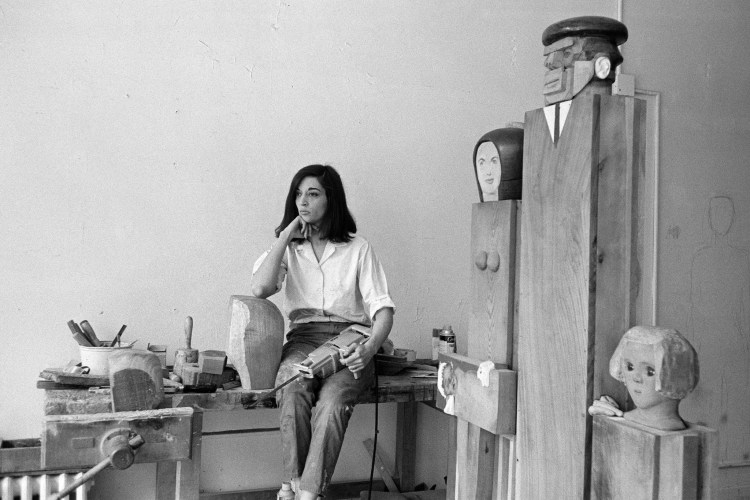
Born on this day, May 22, 1930, in Paris, María Sol Escobar—known throughout the art world simply as Marisol—became one of the most celebrated and unconventional artists of the 1960s. Her life-size figures, carved from heavy blocks of wood and combined with painting, drawing, plaster casts, photographs, clothing, shoes, handbags, doors, and other found objects, looked unlike almost anything else appearing in New York galleries at the time.
Her sculptures could be funny at first glance and unsettling a moment later. Fashionable women gathered stiffly at cocktail parties. Families stared outward from massive wooden bodies. Political leaders became absurd monuments. Celebrities, artists, children, animals, and Marisol herself appeared again and again, sometimes with several versions of her own face occupying the same work.
She was frequently associated with Pop Art, and with good reason. Marisol moved in the same New York circles as Andy Warhol and other artists who were transforming advertising, celebrity culture, consumer products, and mass-media imagery into material for serious art. Yet she never fit comfortably within Pop. Her work drew equally from Surrealism, folk art, pre-Columbian sculpture, portraiture, assemblage, performance, social satire, and intensely personal forms of self-representation.
For a period in the 1960s, Marisol was one of the most famous artists in America. Crowds packed her exhibitions, magazines photographed her, and her enigmatic public persona became almost as discussed as her sculpture.
Then she stepped away.
When she returned, much of the art world had moved on.
For decades, her work was too often treated as a fascinating footnote to Pop Art. More recent scholarship and major museum exhibitions have restored a much broader view of her career, revealing an artist whose concerns with gender, celebrity, identity, consumer culture, environmental destruction, poverty, violence, and self-image feel remarkably contemporary.
Marisol was never simply the glamorous woman standing near Pop Art.
She was one of the artists changing what sculpture itself could be.
🌍 A Childhood Between Countries
Marisol was born María Sol Escobar in Paris to Venezuelan parents. Her family was affluent and traveled frequently, and her childhood moved among France, Venezuela, and the United States.
That international upbringing made geographical identity complicated from the beginning. She was born in France, had deep Venezuelan roots, and eventually built her career in New York. Museums today often describe her as Venezuelan and American, born in France, a formulation that reflects how difficult it is to place her within only one national tradition.
She drew constantly as a child and later remembered art as something that had been present in her life before she even understood it as a profession.
Her childhood was also marked by profound loss. Marisol’s mother died when she was 11 years old. The experience affected her deeply, and she later described periods in which she chose not to speak.
Silence would eventually become part of her adult public persona as well. Journalists were fascinated by an artist who might answer an elaborate question with only a few words and then simply stop talking.
For Marisol, however, art often seemed to perform the communication that ordinary conversation could not.
☀️ Becoming Marisol
During her teenage years, María Sol began using the combined name Marisol.
The name had a lyrical quality, suggesting the Spanish words mar and sol—sea and sun—and it eventually became the sole professional name under which she exhibited.
Dropping the surname also helped create one of the most memorable identities in the New York art world.
Marisol.
One name was enough.
The decision later fit perfectly with the strange combination of visibility and mystery surrounding her. She was immediately recognizable, photographed frequently, and socially connected to some of New York’s most famous artists, yet she revealed relatively little about herself.
Her sculptures often did the opposite.
They multiplied her.
Her hands, lips, faces, photographs, drawings, shoes, and body casts entered her work so frequently that Marisol could seem simultaneously elusive in person and omnipresent in her art.
🎨 Studying Art in Los Angeles and New York
After her family moved to Los Angeles in 1946, Marisol pursued formal art education, studying at institutions that included the Otis Art Institute and Jepson Art Institute.
She also spent time studying in Paris before settling increasingly into New York’s artistic world.
In New York, she studied with several significant artists and teachers, including Yasuo Kuniyoshi, William King, and Hans Hofmann.
Hofmann was particularly important to the development of American Abstract Expressionism, the movement dominating the New York art world during the 1950s.
Marisol initially experimented with painting.
But she did not remain an Abstract Expressionist.
The heroic language of large canvases, sweeping gestures, and emotionally charged brushwork did not provide the direction she wanted.
Instead, she turned increasingly toward sculpture.
🗿 Looking Backward to Move Forward
Ancient and non-European art played an important role in Marisol’s development.
Visits to Mexico and encounters with pre-Columbian sculpture, including ancient figures from western Mexico, offered her an alternative to both conventional European sculpture and the dominant abstraction of New York.
The simplified bodies, frontal poses, and powerful physical presence of these ancient forms helped point toward the blocklike figures that would later become Marisol’s signature.
She did not imitate ancient sculpture directly.
Instead, she absorbed a lesson from it.
A human figure did not need anatomical realism to possess enormous presence.
A rectangular body could still feel alive.
A simplified face could still possess personality.
The idea freed her to build people rather than model them traditionally.
🪵 Discovering Wood
Wood became one of Marisol’s defining materials.
Rather than sculpting the body through the smooth, continuous modeling associated with marble, clay, or bronze, she frequently began with heavy rectangular pieces of timber.
The block remained visible.
A torso might essentially be a box.
A head could emerge partially from a squared wooden form.
Sometimes Marisol carved only enough to suggest a face or body.
Other times she simply drew or painted features directly onto the wood.
She later explained that she had initially drawn faces on wooden blocks as guides for carving, only to realize that the drawing itself could do much of the work.
That discovery became fundamental.
Painting could become sculpture.
Drawing could become sculpture.
A photograph attached to wood could become part of sculpture.
Marisol did not need to choose between two and three dimensions.
She could use both simultaneously.
✏️ Drawing on Sculpture
The relationship between drawing and sculpture is one of the most distinctive qualities of Marisol’s work.
A wooden head might be partly carved and partly drawn.
One side of a figure could appear three-dimensional, while another remained almost flat.
A painted line might suggest clothing without any fabric being present.
A real shoe might suddenly project from the bottom of a rectangular wooden body.
These contradictions make her sculptures feel deliberately unstable.
The viewer recognizes a person.
Then the illusion collapses.
A face becomes a drawing.
A torso becomes lumber.
A hand becomes a plaster cast.
Marisol keeps reminding us that representation is something constructed.
That idea would become increasingly important as she explored identity itself.
🏙️ Entering the New York Art World
Marisol began attracting serious attention during the second half of the 1950s.
Her first solo exhibition in New York came at the Leo Castelli Gallery in 1957, placing her within an emerging contemporary art world that would soon become internationally influential.
Success frightened her as much as it pleased her.
After the attention surrounding her early exhibitions, Marisol left New York for Rome for an extended period. She would repeat this pattern throughout her life: success would arrive, the art world would become overwhelming, and she would travel.
That instinct separated her from artists who carefully cultivated constant visibility.
Marisol could become famous and then vanish.
She eventually returned to New York, however, and by the beginning of the 1960s had developed the sculptural language that would make her a star.
🏠 The Family

Among her major early works is The Family from 1962, now in the collection of the Museum of Modern Art.
The sculpture began with something ordinary: a photograph Marisol found in her studio, apparently left behind by a previous occupant.
The image showed a family of modest circumstances.
Marisol transformed them into monumental wooden figures.
Paint, graphite, tinted plaster, sneakers, a door, and a real doorknob all became part of the sculpture.
The work is large enough that viewers encounter the family almost at their own scale.
Yet the figures do not behave like conventional realistic sculpture.
Their bodies remain blocky.
Some features are drawn.
Objects from real life intrude.
The result is simultaneously intimate and strange.
👪 Looking at the American Family
Family portraits traditionally attempt to present people at their best.
Everyone dresses carefully.
People stand in organized groups.
Expressions are composed for the camera.
Marisol’s The Family refuses that polished ideal.
The figures possess dignity, but the scene also retains the awkwardness and imperfection of everyday life.
Some seem emotionally separated even while physically grouped together.
The sculpture is not simply a portrait of particular people.
It becomes a larger meditation on how families present themselves and how society looks at class, motherhood, childhood, and domestic life.
These questions would appear repeatedly in Marisol’s work.
She was interested in the roles people were expected to perform.
🥤 Love and a Bottle of Coca-Cola
Another 1962 work demonstrates how easily Marisol could move between humor and discomfort.
Love consists primarily of a plaster cast of Marisol’s own face combined with a Coca-Cola bottle inserted into her open mouth.
The sculpture is small, but the image is difficult to forget.
It can be interpreted simultaneously through consumer culture, sexuality, advertising, appetite, and the physical relationship between people and manufactured objects.
Coca-Cola was precisely the kind of mass-market symbol that would become closely associated with Pop Art.
Andy Warhol would famously use Coke bottles as well.
But Marisol’s approach was distinctly physical.
The product does not simply appear as an image.
It enters the body.
Consumerism becomes intimate.
🏛️ The Stable Gallery
A major breakthrough came with Marisol’s 1962 solo exhibition at the Stable Gallery in New York.
The exhibition drew enormous attention.
The Buffalo AKG later acquired The Generals from that show, becoming the first museum to purchase Marisol’s work.
The moment marked her transition from promising artist to major cultural figure.
Her sculptures were immediately accessible enough to draw crowds but strange enough to resist easy interpretation.
Viewers recognized the people, clothing, social situations, and cultural references.
But Marisol distorted them just enough to make ordinary life seem theatrical.
Fashion became costume.
Portraiture became performance.
Society itself began to resemble sculpture.
🐎 The Generals
In The Generals, Marisol turned powerful male figures into a strange equestrian monument.
Her approach to public authority was rarely straightforwardly reverential.
Military leaders, presidents, historical personalities, and celebrities became subjects for her distinctive combination of portraiture and satire.
Traditional monuments attempt to stabilize reputation.
They place famous people on pedestals and encourage viewers to look upward.
Marisol often did the opposite.
By translating famous figures into chunky wood, mixed materials, simplified forms, and absurd arrangements, she could make authority look strangely vulnerable.
The monument became a joke.
But the joke still carried serious questions about power.
👗 Women and Dog
Marisol’s Women and Dog, made in 1963–1964 and now at the Whitney Museum of American Art, is among her most important explorations of gender and identity.
The group presents fashionable women standing together with a dog.
Yet all four female figures are versions of Marisol herself.
Her image appears through carving, photography, drawing, and plaster casts.
One figure even represents Marisol as a child.
The women are stylishly dressed and carefully accessorized. A purse, shoes, clothing details, and the dog contribute to the impression of affluent mid-century femininity.
But the multiplication of Marisol’s own face destabilizes the scene.
Who are these women supposed to be?
Individuals?
Types?
Versions of the same person?
Roles someone puts on?
The work turns social identity into something almost interchangeable.
👠 Fashion as Performance
Marisol’s sculptures frequently paid close attention to clothes.
Dresses, hats, shoes, handbags, and hairstyles could identify class, age, gender, aspiration, and social position almost instantly.
This interest mirrored Marisol’s own reputation.
The press regularly described her appearance, clothing, beauty, and mysterious demeanor. She became a fashion figure as well as an artist, photographed in a way male artists rarely were.
That attention carried an obvious double standard.
Male artists could cultivate eccentric personalities without having their clothes discussed as though fashion were part of their artistic qualification.
Marisol understood how female appearance functioned socially.
Her sculptures repeatedly turned that awareness back toward the viewer.
Clothing in her work does not simply decorate the body.
It helps construct the person.
🥂 The Party

One of Marisol’s most celebrated works of the 1960s was The Party, created in 1965–1966.
The installation presents a gathering of elegant, life-size figures as though visitors have entered a sophisticated social event.
The people are dressed for display.
They appear composed.
The atmosphere suggests fashionable New York society.
But nearly all of the women contain variations of Marisol’s own features.
The artist becomes an entire social gathering.
That transformation is funny, eerie, and psychologically complicated.
A party normally depends upon difference: different personalities, conversations, alliances, performances, and anxieties.
Marisol fills the room with versions of herself.
The result raises a question that would resonate throughout her career: how many selves does one person perform in public?
🪞 Marisol Everywhere
Self-portraiture became one of Marisol’s most persistent strategies.
She cast her own hands.
She cast her face.
She used photographs of herself.
She drew herself.
She inserted her likeness into figures representing both women and men.
At times, her own body almost became another found object.
This repetition was not simply narcissism.
Marisol described making self-images as a way of maintaining a sense of reality and personal existence.
The idea is especially striking given her complicated public persona.
The woman who often refused to explain herself verbally could reproduce herself visually again and again.
The art becomes both disguise and evidence.
👄 The Body as Material
Works such as Drawing with Sculptured Hand demonstrate how literally Marisol could incorporate her own body into art.
A cast hand might project from a work and perform the act of drawing.
A plaster mouth might appear alongside a photograph.
Shoes and clothing could stand in for absent body parts.
The result blurs the line between portrait and object.
A traditional portrait shows what someone looks like.
Marisol asked a stranger question.
How many fragments are necessary before we decide that a person is present?
A hand?
A face?
A photograph?
A shoe?
A name?
Her sculptures dismantle identity and then reconstruct it from pieces.
⭐ Celebrity Becomes Material
Marisol also created portraits of famous people.
Celebrities, artists, cultural figures, and politicians offered ideal material because the public already possessed preconceived images of them.
A celebrity portrait is never simply about a person’s physical appearance.
It is also about reputation.
Publicity.
Myth.
Mass reproduction.
Marisol could take the familiar face of a famous person and translate it into awkward physical form, forcing viewers to reconsider an image they thought they knew.
This interest connected her naturally with Pop Art, which was equally fascinated by fame.
Yet her celebrities often remained stubbornly human rather than becoming endlessly repeatable icons.
🎬 John Wayne
Among the famous figures to appear in Marisol’s work was John Wayne.
The choice made perfect sense.
Wayne represented much more than an individual actor.
By the 1960s, his screen persona had become a symbol of American masculinity, western mythology, patriotism, independence, and a particular vision of national identity.
Turning such a figure into sculpture allowed Marisol to play with the difference between a person and an image.
The Hollywood cowboy becomes an object.
Masculinity becomes costume.
Heroism becomes pose.
Marisol understood that popular culture trains people to recognize types almost instantly.
Her sculptures ask us what happens when those types are made strange again.
🏛️ Politics in Wood
Political figures also became targets of Marisol’s attention.
Her LBJ from 1967 depicts President Lyndon B. Johnson during the turbulent Vietnam-era years.
Marisol’s portraits rarely functioned as conventional political monuments.
The blocky forms and exaggerated physicality could undermine the dignity traditionally associated with official portraiture.
A president might possess enormous institutional power, but inside Marisol’s visual world he could still become awkward, comic, and physically strange.
This tension between seriousness and humor made her political art difficult to categorize.
She did not produce propaganda.
She produced unease.
🎭 Pop Art, But Not Quite
By the middle of the 1960s, Marisol was routinely identified with Pop Art.
The connection is understandable.
She used consumer products.
She portrayed celebrities.
She addressed fashion and mass culture.
She associated socially with artists including Andy Warhol.
Her sculptures appeared during the exact moment when Pop was becoming one of the dominant movements in American art.
Yet Marisol’s materials and methods were very different from the mechanical repetition often associated with Pop.
Her wooden figures were tactile.
Handmade.
Awkward.
Individual.
They retained evidence of carving, drawing, casting, clothing, and found objects.
If Warhol could make celebrity feel mass-produced, Marisol often made mass culture feel strangely handmade.
📸 Fame and the “Latin Garbo”
The press became fascinated with Marisol herself.
She was stylish, beautiful, cosmopolitan, and famously reluctant to speak at length in interviews.
Writers produced exoticizing descriptions, including the nickname “Latin Garbo,” comparing her enigmatic presence with actress Greta Garbo.
Other coverage focused heavily on her appearance.
The attention helped make Marisol famous, but it also distorted understanding of her work.
She was turned into an art-world personality at exactly the moment her sculptures were questioning how identity is manufactured.
The irony is almost too perfect.
Marisol created art about people performing social roles while the media created a role for Marisol to perform.
Eventually, she withdrew from it.
🎥 Around Andy Warhol
Marisol moved through the same New York art scene as Andy Warhol, and the two became part of one another’s cultural orbit during the early 1960s.
Their work shared an interest in celebrity, mass culture, consumer products, social identity, and self-invention.
Yet their personalities and artistic methods were very different.
Warhol increasingly built an enormous public mythology around the Factory, filmmaking, celebrity visitors, and mechanical reproduction.
Marisol cultivated distance.
She could attend the same parties and appear in the same social circles while seeming emotionally elsewhere.
The contrast helps explain why histories of Pop Art built primarily around Warhol, Roy Lichtenstein, and other male artists eventually had difficulty knowing what to do with her.
Marisol had always occupied the category sideways.
🚪 Walking Away From the Art World
At the height of her fame during the late 1960s, Marisol did something unexpected.
She left.
Travel had always been important to her, but this departure became more substantial. She spent extended periods outside New York and removed herself from the highly competitive gallery system that had made her famous.
The decision had consequences.
Art history can be surprisingly dependent upon continuous visibility.
Artists need exhibitions.
Critics need new work to discuss.
Galleries need objects to sell.
Museums follow conversations already happening elsewhere.
When Marisol returned to sustained production, the movements defining contemporary art had changed dramatically.
Her former celebrity could not simply be resumed.
🌊 Beneath the Water
Marisol’s work in the 1970s moved in directions that surprised audiences who expected the witty wooden social figures of the previous decade.
She became deeply interested in scuba diving and marine life.
Underwater experience gave her an entirely different visual world.
Sharks.
Barracudas.
Fish.
Coral.
Bodies moving through water.
The ocean offered forms and movements that had little to do with fashionable New York society.
Marisol created sculptures of marine animals, often combining them with human characteristics or with her own face.
The work could be beautiful and bizarre at the same time.
🐟 Human Becomes Animal
The marine sculptures continued Marisol’s fascination with unstable identity.
Earlier works blurred the boundary between person and wooden block.
Now the human and animal worlds began merging.
A fish could carry Marisol’s face.
A marine creature could become a strange self-portrait.
The shift also opened increasingly ecological possibilities within her work.
Human beings were no longer the unquestioned center of her universe.
The ocean contained lives and intelligences of its own.
Recent scholarship has paid far more attention to this part of her career, connecting it with contemporary concerns about environmental precarity and humanity’s relationship with other species.
What once looked like a detour now seems remarkably forward-looking.
🩰 Sculpture and Dance
Marisol’s creativity also extended into collaboration with dance and performance.
She worked with choreographers and created sculptural environments and designs that could interact with moving bodies.
This was a natural development for an artist who had always treated sculpture almost theatrically.
Her life-size figures behaved like frozen performers.
They occupied rooms.
They dressed for social occasions.
They faced viewers.
They created awkward relationships with one another.
Dance introduced actual movement into that concern with bodies and space.
The sculpture no longer needed to represent a performer.
It could share the stage with one.
✝️ Revisiting The Last Supper
Marisol repeatedly engaged with works from art history rather than limiting herself to contemporary imagery.
One of her most ambitious later projects was Self-Portrait Looking at The Last Supper, created from 1982 to 1984 and now in the Metropolitan Museum of Art.
The enormous installation reimagines Leonardo da Vinci’s famous composition through Marisol’s sculptural language.
The work is nearly 30 feet wide.
Christ and the apostles become blocklike figures assembled from wood and other materials, while Marisol places herself outside the central biblical group as a viewer confronting the scene.
The title is crucial.
This is not simply The Last Supper.
It is Marisol looking at it.
Art history becomes something personal.
🖼️ Talking With Leonardo
Marisol had long admired Leonardo da Vinci, particularly his drawings and studies of the human body.
Her engagement with The Last Supper demonstrates how freely she could move between high art and popular culture.
Coca-Cola bottles belonged in her art.
So did Hollywood stars.
So did Renaissance masterpieces.
Marisol did not accept the idea that some visual sources were serious and others trivial.
All images become part of culture once people begin responding to them.
Leonardo’s apostles and a mid-century handbag could therefore occupy the same artistic imagination.
That breadth is one reason her work resists simple categorization.
🍞 Hunger and Social Inequality
During the 1980s, Marisol increasingly addressed subjects involving poverty, hunger, displacement, and social injustice.
These themes had appeared indirectly in earlier work such as The Family, but they became more explicit later.
Her attention moved away from fashionable cocktail parties toward people whose lives were shaped by economic hardship.
This shift complicates the old idea of Marisol as primarily a witty Pop sculptor.
The humor never disappeared entirely, but the emotional range of the work expanded dramatically.
Her sculptures could be satirical.
They could also be compassionate.
Angry.
Disturbing.
Mournful.
The more of her career we examine, the less adequate the Pop Art label becomes.
🪶 Native American Portraits
During the 1990s, Marisol developed a series of portrait sculptures depicting prominent Native American figures.
The project again demonstrated her sustained fascination with portraiture and historical representation.
Portraits create power partly through selection.
Choosing who deserves to be represented is itself an argument about history.
Marisol had spent decades depicting presidents, artists, entertainers, wealthy women, ordinary families, and herself.
By turning her attention toward Native American figures, she continued expanding the range of people occupying her sculptural world.
The works also fit within her long-running challenge to traditional monuments and official histories.
Who gets remembered?
Who gets turned into an image?
Who gets overlooked?
🗿 Father Damien
Marisol’s public sculpture also became an important part of her later career.
One of her best-known commissions was a monument to Father Damien, the Belgian priest who ministered to people with Hansen’s disease on the Hawaiian island of Molokaʻi.
The project presented a difficult portrait problem.
A conventional heroic monument might idealize its subject.
Marisol instead created a monumental figure retaining the rough, blocklike quality associated with her work.
The sculpture emphasizes both physical presence and human vulnerability.
A version of the Father Damien statue stands in Honolulu, while another is part of the National Statuary Hall Collection at the U.S. Capitol.
Marisol’s private sculptural language had entered official public space.
🧍 Portraiture Without Flattery
Whether depicting a president, celebrity, artist, priest, family, or herself, Marisol rarely seemed interested in conventional flattery.
Her portraits can be affectionate without becoming idealized.
The blocky forms prevent viewers from forgetting that they are constructions.
This gives her portraits an unusual honesty.
People are always partly inventions.
We build public identities through clothing, photographs, professions, poses, social roles, reputations, and other people’s expectations.
Marisol makes those components visible.
Her figures seem assembled because social identity itself is assembled.
That idea gives work from the 1960s an unexpectedly contemporary resonance.
♀️ A Feminist Artist Before the Label Fit Easily
Marisol did not build her career around declaring allegiance to a single artistic ideology, but later generations have increasingly recognized the feminist implications of her work.
Her sculptures examined domestic expectations, beauty, marriage, social performance, motherhood, female friendship, fashion, sexuality, and the way women’s bodies become objects of public scrutiny.
Most powerfully, she repeatedly placed herself inside those representations.
Instead of allowing the female body to exist merely as something looked at, Marisol became both artist and subject.
She controlled the image.
She multiplied it.
She distorted it.
She made it strange.
The Metropolitan Museum of Art now describes her as an important pioneering feminist artist, reflecting a critical understanding that was much less common during her period of greatest fame.
🪞 Identity as Something Constructed
Marisol’s fascination with identity feels especially relevant today.
Her sculptures suggest that the self is never completely stable.
A person can be professional in one setting, glamorous in another, awkward somewhere else, and almost unrecognizable alone.
Photographs create another self.
Clothing creates another.
Public reputation creates another.
Marisol embodied this contradiction in her own life.
The press saw an exotic, glamorous, silent celebrity.
Friends knew another Marisol.
Her artworks contained dozens more.
She refused the idea that one image could explain a person.
🕯️ Fame Fades
As the decades passed, Marisol’s name appeared less frequently in standard accounts of postwar American art.
Pop Art history hardened around a relatively small group of male artists.
Warhol.
Lichtenstein.
Rosenquist.
Oldenburg.
Wesselmann.
Marisol had once been every bit as visible within the contemporary art world, yet she increasingly disappeared from the simplified version of the period taught in surveys and reproduced in exhibitions.
Her decision to travel and step away from constant promotion contributed to the shift.
Gender and cultural assumptions within the art world did as well.
The artist had not stopped working.
The story being told about 1960s art had simply become narrower.
🖼️ Rediscovery
Critical interest in Marisol began growing again substantially during the later years of her life.
Museums and scholars reconsidered the complexity of her work, particularly its engagement with gender, identity, Latin American experience, politics, celebrity culture, and the body.
A major 2014 retrospective organized by the Memphis Brooks Museum of Art and later shown at El Museo del Barrio in New York helped restore broader attention to her career.
This was not simply nostalgia for a once-famous 1960s artist.
The work looked newly relevant.
Issues Marisol had explored decades earlier had become central to contemporary art.
Suddenly, the woman who had seemed difficult to categorize began to look less out of place.
The categories had finally caught up with her.
🎁 A Transformative Bequest
When Marisol died in 2016, she left an extraordinary legacy to the institution now known as the Buffalo AKG Art Museum.
Her bequest included more than 100 sculptures spanning her career, over 150 works on paper, thousands of photographs and slides, archival materials, tools, books, studies, and other parts of her artistic life.
The museum’s relationship with Marisol had begun decades earlier when it became the first institution to acquire one of her works, purchasing The Generals in 1962.
The bequest transformed that relationship.
Buffalo suddenly became the world’s most important center for studying Marisol.
Researchers could examine not just famous sculptures but sketches, photographs, unfinished ideas, later works, and records covering nearly 60 years of artistic practice.
🏛️ Marisol: A Retrospective
That research culminated in Marisol: A Retrospective, the most comprehensive exhibition of her work yet assembled.
Organized by the Buffalo AKG, the exhibition traveled from the Montreal Museum of Fine Arts to the Toledo Museum of Art, Buffalo, and finally the Dallas Museum of Art between 2023 and 2025.
Nearly 250 works appeared in the Buffalo presentation alone.
The scale mattered.
For decades, viewers often encountered Marisol through a few famous sculptures from the 1960s.
The retrospective instead revealed a career stretching from the 1950s into the early 2000s.
Marine life.
Environmental concerns.
Social injustice.
Portraiture.
Public sculpture.
Dance collaborations.
Works on paper.
Political satire.
Self-portraiture.
The wider career changed the meaning of the famous works as well.
🪵 Why the Wood Still Feels Radical
Marisol’s wooden figures remain remarkable partly because they refuse to disappear into illusion.
You always know they are made from wood.
The blocks possess weight.
Edges remain visible.
Surfaces change abruptly from carving to painting.
A realistic hand may emerge from an impossible body.
A photograph may replace a face.
A real handbag may hang beside a painted dress.
The viewer keeps shifting between seeing a person and seeing an object.
That uncertainty gives the sculptures enormous vitality.
They are not mannequins.
They are not traditional statues.
They are not paintings.
They belong to their own category.
🎨 Marisol and the Freedom Not to Fit
Art history prefers movements because movements make complicated periods easier to explain.
Pop Art.
Minimalism.
Conceptual Art.
Abstract Expressionism.
Marisol continually slips between them.
Her work touches Pop but remains intensely handmade.
It anticipates feminist art without belonging neatly to the later movement.
It uses found objects like assemblage.
It borrows the scale and frontal power of ancient sculpture.
It incorporates performance, photography, drawing, painting, architecture, clothing, and autobiography.
For years, that refusal to fit may have made her more difficult to summarize.
Today it looks like one of her strengths.
🌊 An Artist Larger Than the 1960s
Marisol’s 1960s sculptures deserve their fame.
They are witty, visually unforgettable, and central to the history of postwar American art.
But stopping there recreates the same problem that contributed to her decades of neglect.
Her career lasted nearly 60 years.
She changed.
Her subjects changed.
The world changed.
The socialites gave way to marine creatures, historical figures, social commentary, public monuments, and monumental encounters with art history.
The sculptor remained recognizable, but she never simply reproduced The Party forever.
That willingness to move away from what had made her famous required unusual independence.
🕯️ The Final Years
Marisol continued working in New York into the later decades of her life.
She never regained the celebrity status surrounding her in the 1960s, but by the early 21st century a serious reassessment of her achievement was already underway.
Marisol died in New York City on April 30, 2016, at the age of 85.
Her death brought renewed attention to the contradiction that had surrounded her legacy. An artist once considered one of the great stars of the New York art world had become unfamiliar to many younger viewers.
The massive archive and collection she left behind would help change that.
Rather than allowing her career to be reduced to a few photographs and famous sculptures, Marisol effectively provided future scholars with the material necessary to rebuild the story.
👀 Seeing Marisol Again
The renewed attention surrounding Marisol is not simply an effort to insert another name into an established Pop Art timeline.
Her work changes the timeline itself.
It demonstrates that the supposedly masculine world of 1960s American art contained artists investigating gender and selfhood in far more complicated ways than traditional histories suggested.
It reminds us that Latin American and transnational identities were part of the New York avant-garde.
It shows that environmental thinking, the politics of the body, social inequality, and questions about representation were already appearing in forms that scholars are still learning how to interpret.
Most importantly, the rediscovery allows Marisol’s work to stand on its own terms rather than primarily beside more famous men.
✨ Marisol Escobar’s Lasting Legacy
Marisol Escobar became famous by making people out of things that should not have convincingly become people.
Blocks of wood.
Plaster.
Pencil marks.
Photographs.
Shoes.
Handbags.
Doors.
Fabric.
A Coca-Cola bottle.
Somehow, once assembled, they became families, fashionable women, celebrities, presidents, historical figures, animals, artists, and countless versions of Marisol herself.
That process was not merely a clever artistic trick. It expressed something fundamental about how Marisol understood identity. People are assembled too. We construct ourselves through memory, clothing, culture, gender, family, nationality, possessions, photographs, work, public reputation, and the expectations of everyone watching us.
Marisol made those layers visible.
Born María Sol Escobar in Paris on May 22, 1930, she carried Venezuelan heritage, European experience, and an American artistic career within the same complicated identity. She became a celebrity and then rejected celebrity. She belonged to Pop Art without ever fully becoming a Pop artist. She turned herself into her favorite model while remaining famous for silence and mystery.
For a time, the art world seemed to forget her.
The sculptures did not forget themselves.
They remained in museums and collections, still staring outward with their wooden bodies, drawn faces, cast hands, strange accessories, and unsettling humor.
Today, Marisol’s work looks less like an eccentric branch of 1960s art and more like a remarkably prescient exploration of questions artists continue asking: Who gets seen? Who controls the image? How much of identity is performance? What happens when society turns people into objects—and what happens when an artist turns objects back into people?
Marisol spent nearly six decades answering those questions without ever settling on a single answer.
That may be why her art feels so alive again.
🔗 Related Articles
- Ellsworth Kelly: Color, Shape & the Art of Seeing
- The Brilliance of Sol LeWitt: A Journey Into Geometric Abstraction
- Raoul Dufy: Color, Light & the Joy of Modern Life
- George Nakashima: Craft, Nature & the Soul of Wood
- Art & Design: Modern Art, Mid-Century Design & Creative Culture
📚 Sources & Further Reading
- Buffalo AKG Art Museum — Marisol
- Buffalo AKG Art Museum — Marisol: A Retrospective
- Buffalo AKG Art Museum — Marisol: A Retrospective Catalogue
- Buffalo AKG Art Museum — Marisol: Works on Paper
- Museum of Modern Art — Marisol
- Museum of Modern Art — The Family
- Museum of Modern Art — Love
- Whitney Museum of American Art — Marisol
- National Gallery of Art — Who Is Marisol? 7 Things to Know
- Smithsonian American Art Museum — Marisol
- The Metropolitan Museum of Art — Self-Portrait Looking at The Last Supper


