
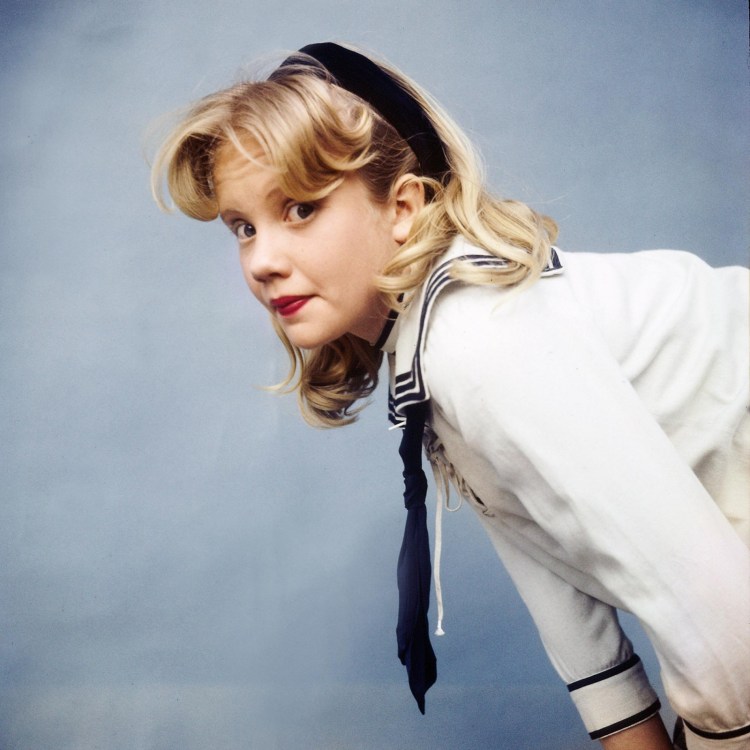
Born in London on April 18, 1946, Hayley Mills became one of the most recognizable young movie stars of the 1960s. With her bright, natural screen presence and an ability to move easily between comedy, adventure, and drama, she became closely associated with a remarkable run of Walt Disney live-action films while also building a career in British cinema that revealed a much wider range.
For generations of viewers, Mills will always be Pollyanna, the optimistic orphan who changes an entire town, or Susan and Sharon, the separated twins plotting to reunite their parents in The Parent Trap. Yet those beloved performances were only part of a career that began with a surprisingly dark British thriller and continued through film, television, and the stage for decades.
🎬 Growing Up in a Theatrical Family
Hayley Mills was born into a family already deeply connected with the arts. Her father, Sir John Mills, was one of Britain’s best-known actors, while her mother, Mary Hayley Bell, was an actress, novelist, and playwright. Her older sister Juliet Mills also became an actress.
Despite that background, Hayley’s arrival in the movies was not simply the result of being placed on screen by her famous parents.
Director J. Lee Thompson was preparing the 1959 thriller Tiger Bay with John Mills when he noticed Hayley. The story originally called for the child at the center of the film to be a boy, but Thompson was so impressed by the young Mills that the part was rewritten for her.
She was only 12 when she played Gillie, a tough, curious child who witnesses a murder and forms an unexpected bond with the man responsible. It was an unusually complicated role for a young performer, requiring Mills to be funny, frightened, rebellious, deceptive, and sympathetic without turning the character into the sort of overly sentimental child often seen in movies of the period.
🏆 Tiger Bay Changes Everything
Tiger Bay immediately established Mills as more than a novelty.
Her performance earned her the BAFTA Award for Most Promising Newcomer to Film, making the movie one of the most important turning points of her career. The film itself was notable for its extensive location photography around Cardiff and its tougher, more realistic portrayal of childhood, placing it close to the emerging British New Wave of the late 1950s and early 1960s.
Someone else was paying attention as well.
Disney’s own history notes that Walt Disney’s wife, Lillian Disney, saw Mills in Tiger Bay and drew her husband’s attention to the young actress. Walt was searching for a performer capable of carrying a new adaptation of Eleanor H. Porter’s novel Pollyanna.
Before long, Mills was headed for Hollywood.
🌈 Becoming Disney’s Pollyanna
Released in 1960, Pollyanna introduced Hayley Mills to a vast American audience.
She plays the newly orphaned Pollyanna, who arrives in the small town of Harrington to live with her wealthy and stern Aunt Polly. Pollyanna’s habit of looking for something positive even in difficult circumstances gradually affects the people around her, from lonely residents to quarreling neighbors.
The character could easily have become unbearably sweet in less capable hands. Mills gave her energy, stubbornness, humor, and sincerity, allowing the optimism to feel like part of a believable personality rather than simply a lesson for the audience.
The performance was enormously successful. At the 33rd Academy Awards, Mills received a special Honorary Academy Award recognizing the most outstanding juvenile performance of 1960. It was one of the final examples of the special juvenile Oscar that had occasionally been presented to exceptional young performers since the 1930s.
Ironically, Mills was not present to accept it. Annette Funicello and Shirley Temple accepted on her behalf.
👯 Double Trouble in The Parent Trap
If Pollyanna made Mills a star, The Parent Trap made her an enduring part of popular culture.
Released in 1961, the film gave Mills not one starring role but two. She played identical twins Susan Evers and Sharon McKendrick, who were separated as babies when their parents divorced. Neither girl initially knows the other exists until they unexpectedly meet at summer camp.
After the initial shock—and a memorable period of rivalry—the twins discover the truth and devise a plan. They secretly switch places, each traveling home to the parent she has never known, while working toward the larger goal of reuniting their mother and father.
The illusion of two Hayley Millses occupying the same scene was created with techniques including split-screen photography, double exposure, and a body double. The effect was remarkably convincing for audiences in 1961 and became one of the movie’s defining achievements.
Just as important was Mills’ performance. Susan and Sharon needed to look identical while still feeling like two separate girls, and Mills differentiated them through mannerisms, speech, posture, and personality.
🎵 “Let’s Get Together”
The Parent Trap also unexpectedly gave Hayley Mills a pop-music career.
In the movie, Susan and Sharon perform “Let’s Get Together,” written by Richard M. Sherman and Robert B. Sherman. The catchy song became popular enough to be released as a record, and Mills subsequently recorded additional music for Disney.
Richard Sherman later recalled that young moviegoers were even bringing small tape recorders into theaters to capture the song. Mills released an album titled Let’s Get Together, tying her movie stardom to the teen-pop culture of the early 1960s.
It was an unusual extension of her Disney image. Hayley Mills was suddenly not only a movie star but a familiar voice coming from record players as well.
🏰 Hayley Mills’ Disney Years
Walt Disney signed Mills to a five-year contract, beginning one of the most memorable partnerships between the studio and a young live-action performer.
After Pollyanna and The Parent Trap, she appeared in In Search of the Castaways in 1962, an adventure based on the Jules Verne novel. She followed it with the nostalgic Summer Magic in 1963, The Moon-Spinners in 1964, and the comedy-mystery That Darn Cat! in 1965.
These films helped define Disney’s live-action identity during the early 1960s. Rather than animated princesses or fantasy kingdoms, they often offered family adventures, mysteries, small-town stories, travel, animals, and young protagonists who found themselves caught in unexpectedly complicated situations.
Mills was particularly well suited to them because she never seemed helpless. Her characters tended to investigate, interfere, argue, explore, and take matters into their own hands.
🌾 Whistle Down the Wind
While Disney was establishing Mills as one of America’s favorite young stars, she continued making films in Britain.
One of the finest was Whistle Down the Wind, released in 1961. Based on a novel written by her mother, Mary Hayley Bell, the story follows children who discover an injured fugitive hiding in a barn. When they ask who he is and he responds with an exclamation involving Jesus Christ, the children misunderstand him and become convinced they have actually found Jesus.
The premise allows the film to move between childhood innocence and the far harsher adult world surrounding the children.
Mills played Kathy, the oldest of the children, opposite Alan Bates as the fugitive. More than six decades later, Mills recalled that the children in her mother’s original story had been loosely inspired by Hayley, Juliet, and their brother Jonathan.
The movie remains a striking example of how different her British work could be from her Disney films.
👼 The Trouble with Angels
As Mills grew older, the challenge became escaping an image built around cheerful, wholesome adolescence.
The Trouble with Angels, released in 1966, provided something of a bridge. Directed by pioneering actress and filmmaker Ida Lupino, the comedy stars Mills and June Harding as mischievous students at a Catholic boarding school constantly testing the patience of Mother Superior, played by Rosalind Russell.
Mills’ Mary Clancy is clever, rebellious, and continually dreaming up new schemes. Yet beneath the comedy, her relationship with Mother Superior gradually becomes more complex.
The film arrived just as Mills was leaving her Disney years behind. Turner Classic Movies notes that it was her first movie after the conclusion of her Disney contract, even though its wholesome tone remained close to the screen image audiences associated with her.
🎞️ Growing Beyond the Disney Image
The transition from child star to adult performer has ended many promising careers, and Mills later pursued roles that deliberately moved beyond what audiences expected from the girl in Pollyanna.
In 1966 she appeared in The Family Way, a British comedy-drama dealing with the difficulties faced by a newly married young couple. Later movies included Endless Night, adapted from Agatha Christie, and Deadly Strangers.
These roles were far removed from the uncomplicated image of Disney family entertainment. They also marked a natural transition for an actress who could not remain a teenager forever.
That transition was not always easy. Mills had become famous so young that audiences felt they knew her, and the characters she played at Disney had created particularly strong expectations about who she was supposed to be.
Her career after Disney therefore became partly a story about growing up in public.
📺 Returning to The Parent Trap
Hayley Mills never completely left her Disney past behind.
Twenty-five years after the original movie, she returned to the dual roles of Susan and Sharon for The Parent Trap II, which premiered on the Disney Channel in 1986. This time, another generation of children becomes involved in matchmaking, with Sharon’s daughter helping engineer a new romance.
Mills subsequently appeared in additional Parent Trap television sequels, including Parent Trap III and Parent Trap: Hawaiian Honeymoon.
The original story received an entirely new life in 1998 when Disney remade The Parent Trap with Lindsay Lohan playing twins Hallie and Annie. Although Mills did not appear in the remake, the film introduced essentially the same irresistible premise to another generation.
Few child-star performances have had such an unusually long afterlife.
🍎 From Disney Movies to Good Morning, Miss Bliss
Mills also returned to Disney television in Good Morning, Miss Bliss, playing teacher Carrie Bliss.
The series originally aired on the Disney Channel in the late 1980s and followed Miss Bliss and her students at an Indianapolis junior high school.
The program itself had a curious afterlife. Following its cancellation, several of its young characters were retained and reworked into a different series set in California.
That new program became Saved by the Bell.
For viewers accustomed to seeing Mills as the adventurous child or teenager, Good Morning, Miss Bliss reversed the situation. She was now the responsible adult trying to guide a classroom filled with young people toward better decisions.
🎭 A Career Beyond the Movie Screen
Mills’ career has also included extensive work in theater and television.
In 1997, she made her American stage debut as Anna Leonowens in a touring production of Rodgers and Hammerstein’s The King and I. She has appeared in numerous stage productions in Britain and the United States while continuing to work regularly on television.
Her later television credits have ranged across dramas and family productions, demonstrating a longevity that few performers who became famous as children manage to achieve.
The continuing career matters because it changes the way we understand the early Disney films. Mills was not simply a child star who belonged to one nostalgic era. She became a working actress whose career stretched across generations of film, television, and theater.
🏅 Becoming a Disney Legend
In 1998, Hayley Mills was officially named a Disney Legend.
The honor recognized a relationship with Disney that had begun nearly four decades earlier with Pollyanna. By then, movies such as The Parent Trap, Summer Magic, and That Darn Cat! had become nostalgic favorites for adults who had first encountered them as children, while television and home video were introducing them to new audiences.
Her association with Disney is unusually strong because it was built around personality rather than a single character.
Mills could be optimistic Pollyanna, two feuding twins, an adventurer crossing the world, a teenager solving mysteries in Greece, or a young woman chasing a mischievous cat through suburban America.
The common element was Hayley Mills herself.
🌟 Why Hayley Mills Still Stands Out

Many child actors are remembered primarily because audiences feel nostalgic about the movies they appeared in.
Hayley Mills deserves more than nostalgia.
Watch Tiger Bay and the naturalism is already there. Watch Pollyanna and she manages to make relentless optimism feel emotionally convincing. Watch The Parent Trap and it becomes surprisingly easy to forget that Susan and Sharon are being played by the same person.
That versatility helps explain why her early films have endured.
Mills belonged to a transitional moment in movie history as well. Her career connects postwar British cinema with Walt Disney’s expanding live-action filmmaking, early-1960s youth culture, family entertainment, British cinema of the Swinging Sixties, and eventually the rise of cable television.
Few performers can connect so many different corners of mid-century popular culture.
☄️ Hayley Mills & the Movies of a Generation
For Comet Atomic, Hayley Mills represents one of the most appealing sides of 1960s cinema.
Her movies are filled with summer camps, old houses, station wagons, record players, European adventures, small towns, seaside landscapes, eccentric adults, mysteries, and children determined to solve problems without waiting for grown-ups to do it for them.
Yet beneath the nostalgia is a genuinely gifted performer.
Hayley Mills could make audiences believe in Pollyanna’s determination to find something good in almost everyone. She could play two sisters in the same movie and make us recognize immediately which one we were watching. She could step out of Disney’s brightly colored world and into the darker landscapes of British cinema without seeming misplaced.
More than six decades after her breakthrough, those performances remain lively, funny, and remarkably easy to return to.
The little girl discovered in Tiger Bay did much more than become a successful child star.
She became part of movie history.
🔗 Related Articles
- Celebrating Pollyanna: A Timeless Classic Released on May 19, 1960
- Milt Kahl: The Master Animator Who Helped Define Disney Style
- Film & Animation: Classic Cinema, Animation & Movie History
- Mid-Century Culture: Design, Style & Everyday Life From the Atomic Age
- On This Day: Artists, Musicians, Filmmakers & Cultural Icons
📚 Sources & Further Reading
- D23 — Hayley Mills
- BAFTA — Most Promising Newcomer to Film
- Academy of Motion Picture Arts and Sciences — The 33rd Academy Awards
- Turner Classic Movies — Tiger Bay
- D23 — The Parent Trap
- Turner Classic Movies — The Trouble with Angels
- D23 — Parent Trap II
- The Guardian — Hayley Mills on Whistle Down the Wind


