
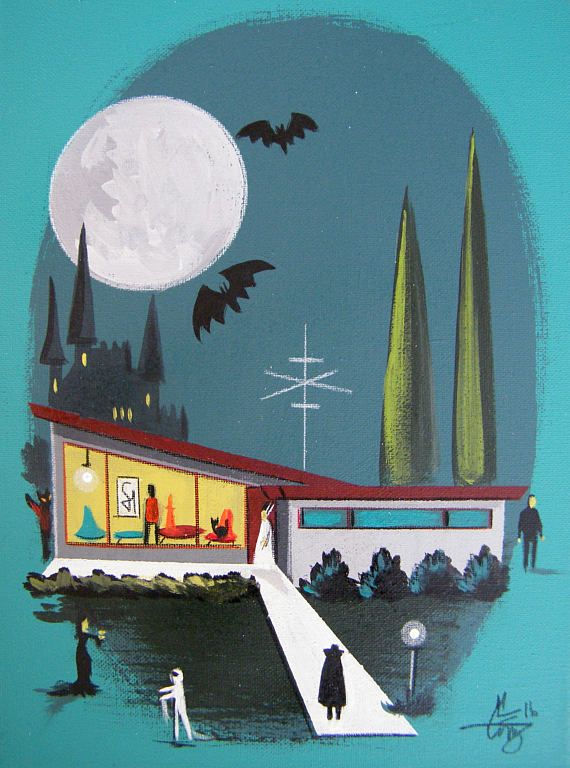
Halloween in mid-century America occupied a wonderfully strange space between old-fashioned harvest traditions and the rapidly expanding world of television, advertising, supermarkets, suburbia, and mass-produced pop culture. By the 1950s and 1960s, the holiday had become increasingly recognizable as the Halloween celebrated today: children roaming neighborhoods with bags of candy, drugstores filled with boxed costumes and plastic masks, television monsters flickering in darkened living rooms, and familiar characters from cartoons, comic books, movies, and the Space Age appearing on front porches every October 31.
The result was a Halloween perfectly suited to the mid-century world. It mixed witches, ghosts, jack-o’-lanterns, and homemade decorations with superheroes, astronauts, movie monsters, television characters, packaged candy, novelty records, and an expanding universe of Halloween merchandise. For a generation growing up with television and the promise—or anxiety—of the Atomic Age, Halloween became a night when virtually anything seen on a screen, magazine cover, comic-book page, or toy-store shelf might become a costume.
🎃 Halloween Moves Into the American Neighborhood
Halloween was already well established in the United States before the 1950s, but the postwar decades helped turn trick-or-treating into a widespread neighborhood ritual. Earlier celebrations had often centered on parties, fortune-telling games, pranks, homemade refreshments, costumes, and community gatherings. Door-to-door customs existed as well, but the familiar evening procession of costumed children collecting treats became especially prominent during the middle of the twentieth century.
The postwar suburban landscape was almost made for trick-or-treating. Large neighborhoods filled with families placed hundreds of front doors within walking distance, while streets, schools, churches, civic organizations, and local businesses provided a ready-made network for community celebrations. Halloween could be organized around children without losing its playful association with mischief and the supernatural.
The holiday still had a homemade character. Families carved pumpkins, made decorations from construction paper and crepe paper, assembled costumes from clothes found around the house, played party games, and served popcorn balls, apples, cookies, doughnuts, cider, and homemade sweets. But the growing consumer culture of the 1950s was quickly changing what Halloween looked like.
The transformation was part of the larger story of how Halloween developed into one of America’s most recognizable popular celebrations, combining very old customs with traditions created or transformed in the twentieth century.
🍬 The Rise of the Halloween Candy Haul
A mid-century trick-or-treat bag could contain far more than miniature candy bars. Children might receive apples, nuts, coins, cookies, popcorn balls, small toys, homemade candy, or full-size pieces of packaged candy. Yet during the 1950s, commercially wrapped sweets became increasingly important to the ritual.
Candy manufacturers recognized Halloween as an opportunity and began promoting their products specifically for trick-or-treating. Individually wrapped candy was convenient, easy to distribute, and increasingly inexpensive when purchased in quantity. It also fit naturally into a postwar consumer culture in which supermarkets and nationally advertised brands were becoming more important parts of everyday life.
Some candies already had long histories before they became Halloween staples. Candy corn dated to the nineteenth century, while products such as Baby Ruth, Dubble Bubble, M&M’s, and Almond Joy had appeared well before or during the early postwar years. What changed was the degree to which candy became connected specifically with October 31.
The transition was gradual. Homemade treats remained common through the 1950s and 1960s, and many children returned home with a gloriously inconsistent collection of fruit, baked goods, coins, gum, and candy. But the direction was clear. The modern Halloween candy haul—with its brightly colored wrappers, recognizable brands, and enormous bowl of individually packaged treats—was taking shape.
For an even broader look at how sweets became inseparable from October 31, the history of Halloween candy reveals how dramatically trick-or-treating changed over the twentieth century.
👻 The Boxed Costume Takes Over
Perhaps no object captures mid-century Halloween more perfectly than the boxed costume.
Open the cardboard package and there might be a thin printed smock accompanied by a molded plastic mask held in place with an elastic band. The eye openings were tiny, the mask became warm almost immediately, and visibility was often questionable, but to a child standing in a five-and-dime store, the transformation could feel complete.
Costume companies such as Ben Cooper helped make these inexpensive outfits fixtures of American Halloween. The company had been founded in 1937, but television and licensing created extraordinary opportunities during the postwar decades. Traditional witches, skeletons, devils, pirates, and ghosts now shared store shelves with recognizable figures from entertainment.
This represented an important shift. A Halloween costume no longer needed to portray a general type of character. A child could become a specific character they had watched on television.
Davy Crockett, Superman, Zorro, Disney characters, cartoon figures, cowboys, television personalities, superheroes, and eventually characters tied to an ever-expanding entertainment industry transformed Halloween into another expression of fandom. By the 1960s, the connection between costumes and popular media had become firmly established.
There was still plenty of room for a sheet with eyeholes or one of Dad’s oversized jackets. Homemade costumes never disappeared. But Halloween had entered the age of licensing.
📺 Television Brings the Monsters Home

Television changed Halloween even when October 31 was months away.
In 1957, Screen Gems released a syndicated television package known as Shock! featuring dozens of older horror films, including movies associated with Dracula, Frankenstein’s monster, the Mummy, the Invisible Man, and the Wolf Man. Films that had frightened theater audiences decades earlier suddenly appeared in American living rooms.
Local stations often surrounded the films with elaborate horror-host presentations. Hosts dressed as ghouls, vampires, undertakers, witches, and assorted creatures introduced movies with jokes, props, sound effects, and deliberately macabre humor. Vampira had already demonstrated the potential of the television horror host in Los Angeles earlier in the decade, and figures such as Zacherley soon developed devoted followings of their own.
The revival gave the classic monsters an extraordinary second life. Children who had never experienced the original theatrical releases became fans of creatures created before they were born.
The phenomenon quickly spread beyond television. Famous Monsters of Filmland appeared in 1958, filling its pages with photographs and stories about horror movies and their stars. During the following decade, monster fans could find model kits, toys, trading cards, masks, magazines, posters, records, and costumes.
The old Universal monsters had become part of the new consumer culture.
That monster revival is one reason mid-century horror and science fiction remain such revealing windows into the Atomic Age. Creatures created in earlier decades now existed beside radioactive giants, alien invaders, mutants, robots, and other distinctly modern nightmares.
🧛 Monster Mania Meets Halloween
By the early 1960s, monsters were no longer confined to genuinely frightening horror films. They could be funny, collectible, musical, or even lovable.
Bobby “Boris” Pickett and the Crypt-Kickers released “Monster Mash” in 1962, turning the vocabulary of classic horror into a dance-party novelty record. The song reached No. 1 shortly before Halloween, with Dracula, laboratory experiments, ghouls, and monsters transformed into participants in an irresistible pop-culture joke.
Monster imagery appeared everywhere. Children assembled plastic models of Frankenstein’s monster and Dracula. Horror magazines celebrated makeup artists and actors. Television reruns introduced old films to new audiences. Monster toys, board games, trading cards, and costumes filled stores.
This was horror adapted to the world of the baby boom.
The monsters could still be creepy, but they were also increasingly familiar. Frankenstein’s monster could appear on a television screen one night and on a cereal-box-style piece of merchandising the next. Dracula could inspire both nightmares and jokes.
Halloween became the natural annual celebration of this monster culture.
🚀 Astronauts, Aliens & Atomic Age Costumes
Not every mid-century Halloween costume came from the haunted house. Some came from outer space.
The Space Race turned astronauts into heroes, while movies and television filled the popular imagination with flying saucers, robots, rockets, aliens, and distant planets. Halloween gave children a chance to enter that world themselves.
Costume manufacturers produced astronaut outfits during the 1960s, including variations inspired by the American space program. Other costumes drew on science-fiction programs or simply borrowed the visual vocabulary of the era: metallic surfaces, helmets, ray guns, rockets, stars, and futuristic lettering.
It was a distinctly Atomic Age form of make-believe. A neighborhood might contain witches and ghosts that would have been familiar generations earlier, but they could now be joined by astronauts, robots, Martians, superheroes, and space adventurers.
Halloween had always encouraged fantasy. Mid-century America simply gave children an entirely new collection of fantasies to choose from.
📺 Charlie Brown Enters the Pumpkin Patch

Television did more than revive monsters. It also helped establish Halloween programming as a seasonal tradition.
It’s the Great Pumpkin, Charlie Brown first aired in 1966. Charles M. Schulz’s Peanuts characters already occupied a central place in American popular culture, but their Halloween special captured the holiday with unusual precision.
There were costumes, trick-or-treating, pumpkins, candy, a Halloween party, autumn leaves, and the strange mixture of excitement and disappointment that children sometimes experience during holidays. Linus waited faithfully for the Great Pumpkin while Charlie Brown endured one of the most famously unsuccessful trick-or-treat excursions in television history.
The special helped demonstrate how naturally Halloween fit the television age. A holiday once celebrated primarily through local customs could now have shared national rituals. Families separated by thousands of miles could watch the same Halloween program on the same evening.
Seasonal television would become increasingly important in later decades, but the Great Pumpkin arrived at exactly the right cultural moment.
🕸️ Decorating the Atomic Age Way
Mid-century Halloween decorating could be surprisingly simple. Paper skeletons, black cats, witches, honeycomb pumpkins, cardboard cutouts, crepe-paper streamers, candles, jack-o’-lanterns, and handmade school crafts supplied much of the atmosphere.
Vintage decorations often used exaggerated orange-and-black graphics that remain immediately recognizable today. Grinning pumpkins, arched-back cats, crescent moons, owls, witches riding broomsticks, and wide-eyed ghosts belonged to a visual tradition that had developed long before the 1950s, yet the imagery continued to thrive alongside newer influences.
The era’s graphic design occasionally added its own personality. Bold printing, cartoon illustration, colorful packaging, advertising art, and inexpensive novelty goods gave Halloween an increasingly commercial visual identity.
The contrast could be wonderful: a streamlined television set glowing in the living room while an old-fashioned paper witch hung in the window.
That mixture of new and old was part of Halloween’s appeal.
🍎 A Holiday That Was Still Surprisingly Homemade
It is easy to remember the 1950s and 1960s through surviving products—boxed costumes, candy wrappers, television programs, records, masks, and decorations—but much of Halloween remained resolutely homemade.
Children cut masks from paper bags, parents improvised costumes, teachers covered classroom walls with construction-paper pumpkins, and families carved real jack-o’-lanterns rather than buying elaborate outdoor displays. Parties relied on familiar games and simple food. Neighborhoods themselves provided most of the entertainment.
The Library of Congress has preserved descriptions and newspaper material from the period showing Halloween parties with games, homemade decorations, seasonal recipes, costumes, apples, and other traditions that would have been familiar to earlier generations.
Mass culture did not erase the older Halloween. It layered itself on top of it.
That is one reason the period remains so visually fascinating. A child wearing a mass-produced television-character mask could carry a pillowcase from house to house, receive a homemade popcorn ball at one door and branded candy at the next, return home to watch an old monster movie on television, and finish the evening beneath paper decorations that looked as though they belonged to Halloween decades earlier.
🦇 Why Atomic Age Halloween Still Feels Familiar
Look closely at Halloween in the 1950s and 1960s and much of the modern holiday is already there.
Neighborhood trick-or-treating had become a major childhood ritual. Candy companies increasingly treated October as an important selling season. Licensed costumes turned pop culture into wearable merchandise. Television created shared Halloween entertainment. Classic monsters became permanent cultural icons. Superheroes and science-fiction characters expanded the range of costumes far beyond witches and ghosts.
Yet the holiday had not become completely commercialized. Homemade costumes, neighborhood parties, school crafts, apples, popcorn balls, hand-carved pumpkins, and paper decorations remained central to the experience.
That combination may explain the lasting appeal of Atomic Age Halloween. It belonged simultaneously to the old spooky world and the bright new world of postwar America. Dracula met the astronaut. The homemade ghost costume met the plastic television-character mask. The neighborhood candy bowl met national advertising. The flickering jack-o’-lantern sat beside the glowing television screen.
Halloween had always been good at borrowing from the culture around it. In the 1950s and ’60s, the culture surrounding it happened to be filled with monsters, rockets, superheroes, television stars, candy wrappers, plastic masks, novelty records, and visions of the future.
It was practically made for October 31.
🔗 Related Articles
- Mid-Century Culture: Design, Style & Everyday Life From the Atomic Age
- Film & Animation: Classic Cinema, Animation & Movie History
- Halloween Haunt
- The History of Halloween Candy: How Trick-or-Treating Became So Sweet
📚 Sources & Further Reading
- Smithsonian National Museum of American History — From Homemade Halloween Treats to Colorfully Packaged Candies
- Smithsonian National Museum of American History — Halloween Highlights Arise from the Museum Vaults
- Library of Congress — The Origins of Halloween Traditions
- Library of Congress — Cooking Up History: Homemade Halloween
- SFO Museum — Classic Monsters: The Kirk Hammett Collection
- UNICEF USA — History of Trick-or-Treat for UNICEF
- Smithsonian National Museum of American History — Animation Cel from It’s the Great Pumpkin, Charlie Brown
- The Sixth Floor Museum at Dealey Plaza — Ben Cooper U.S. Astronaut Halloween Costume


