
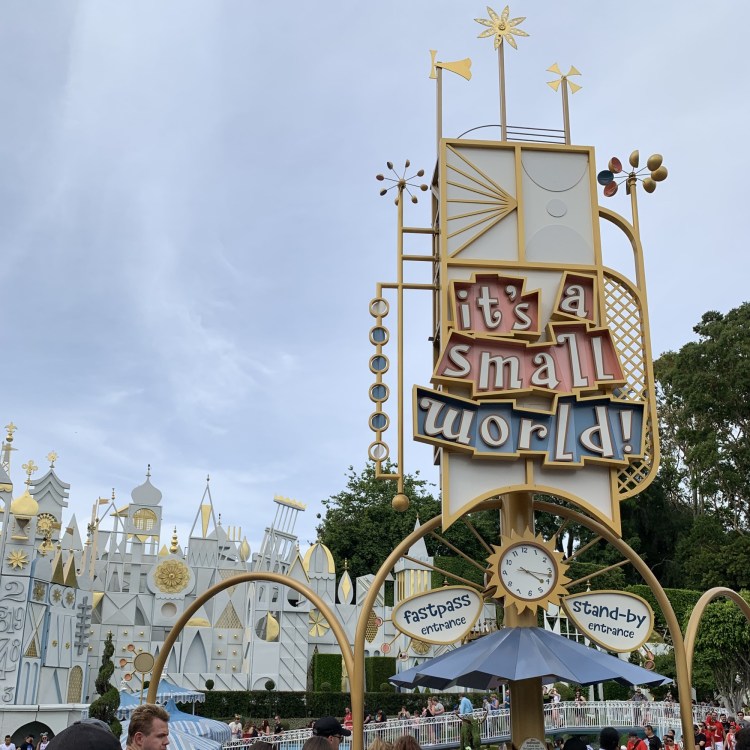
On May 28, 1966, Disneyland opened one of the most recognizable attractions ever created: “it’s a small world.” Guests boarded small boats and sailed through an impossibly colorful world populated by singing children, spinning flowers, playful animals, geometric buildings, and hundreds of tiny details set to a melody almost guaranteed to remain in their heads for the rest of the day.
By the time the attraction reached Disneyland, however, millions of people had already experienced an earlier version. “it’s a small world” had been created for the 1964–1965 New York World’s Fair, where Walt Disney and his Imagineers developed it as a celebration of the children of the world for a UNICEF pavilion sponsored by Pepsi-Cola.
The attraction brought together an extraordinary collection of Disney talent. Mary Blair provided the bold color and stylized visual language. Marc Davis helped shape the characters and their movements. Alice Davis designed hundreds of costumes inspired by clothing from cultures around the world. Rolly Crump created fantastical architectural and decorative elements, including the unforgettable Tower of the Four Winds at the World’s Fair and the animated clock that later greeted Disneyland visitors. Richard and Robert Sherman supplied the deceptively simple song that tied everything together.
More than six decades after its creation, the attraction remains one of Disney’s clearest expressions of mid-century optimism. It is simultaneously a theme-park ride, a giant kinetic artwork, a musical composition, a product of 1960s technology, and an idealistic vision of a world in which cultural differences can exist inside one harmonious whole.
🌎 A World’s Fair About the Future
The 1964–1965 New York World’s Fair was filled with enormous corporate pavilions, futuristic technology, new automobiles, transportation concepts, elaborate architecture, and optimistic visions of what modern life might become.
Walt Disney’s organization became responsible for four major attractions at the Fair. General Electric sponsored Progressland and the Carousel of Progress, Ford presented Magic Skyway, the State of Illinois featured Great Moments with Mr. Lincoln, and Pepsi-Cola sponsored the UNICEF pavilion that became home to “it’s a small world.”
These projects were enormously important to Disney. They allowed Walt and his creative teams to experiment with Audio-Animatronics, transportation systems, large-scale storytelling, crowd movement, corporate sponsorship, and other ideas that could eventually influence Disneyland and Walt Disney World.
“it’s a small world” was different from the technologically ambitious Lincoln and Carousel attractions, however. Walt described a comparatively simple idea: guests would ride boats through scenes representing children from around the world.
The apparent simplicity concealed an enormous design challenge.
🌐 A Salute to the Children of the World
Pepsi-Cola sponsored the pavilion in support of UNICEF, and the Disney attraction was conceived as a salute to children around the world.
The theme fit naturally with the World’s Fair ideal of international cooperation. Rather than presenting countries through realistic architectural reproductions or museum-like displays, Disney approached the world through a child’s imagination.
Countries and regions became simplified combinations of landmarks, costumes, animals, patterns, music, colors, and playful architectural forms. The attraction was never intended to function as a literal geography lesson. It created an imaginary world in which cultures could remain visually distinct while participating in the same enormous performance.
Children became the common element connecting everything.
That basic idea would remain intact even as “it’s a small world” moved across the country and eventually around the globe.
⏱️ Building a World in Less Than a Year
The attraction arrived relatively late in the development of Disney’s World’s Fair projects. Imagineers were already deeply involved with technologically demanding projects when Walt announced that another attraction needed to be created for the UNICEF pavilion.
Disney designer Rolly Crump later remembered the team’s surprise that Walt wanted to add what sounded like a modest “little boat ride” while they were already developing sophisticated Audio-Animatronics for other pavilions.
The timetable was exceptionally tight.
Designers, artists, engineers, costumers, musicians, model makers, sculptors, and technicians had to create an entire world rapidly enough for it to be shipped to New York and assembled before the Fair.
Rather than limiting creativity, the pressure seems to have encouraged an unusually unified design.
Much of that unity came from Mary Blair.
🎨 Mary Blair Creates the World
Few artists left a more distinctive visual mark on Disney’s mid-century period than Mary Blair.
Blair had contributed concept art and color styling to films including Saludos Amigos, The Three Caballeros, Cinderella, Alice in Wonderland, and Peter Pan. Her work was recognizable through bold blocks of color, simplified geometry, playful proportions, folk-art influences, and an ability to make sophisticated design look completely natural to children.
Walt Disney admired her work and brought her into the “small world” project as art director.
Her influence is everywhere.
Mountains become triangles.
Buildings lean and stack like children’s toys.
Flowers appear enormous.
The sun becomes a smiling geometric symbol.
Traditional architectural elements are reduced to their most immediately recognizable shapes and rearranged into something closer to collage than conventional scenic design.
The attraction feels less like traveling through miniature versions of actual countries than sailing through one of Blair’s illustrated books.
🌈 Color Becomes Architecture
Color does much of the storytelling inside “it’s a small world.”
Blair had an extraordinary ability to place colors together that might appear surprising in isolation but harmonious within a larger composition. Pinks, oranges, turquoise, yellow, violet, blue, green, white, and gold appear throughout the attraction without the result collapsing into visual chaos.
The colors help distinguish regions while simultaneously unifying them.
A European village may differ dramatically from an Asian landscape or a South American scene, yet Blair’s underlying visual language makes everything belong to the same imaginary world.
This is one reason the attraction remains so recognizable even in photographs with no Disney characters visible.
The style itself has become the identity.
✏️ Marc Davis and the Characters
Disney Legend Marc Davis played another major role in developing the attraction.
Davis had been one of Disney animation’s legendary “Nine Old Men,” contributing to characters in films including Cinderella, Alice in Wonderland, Peter Pan, Sleeping Beauty, and One Hundred and One Dalmatians. As his career shifted toward theme-park design, he brought the principles of character animation into three-dimensional attractions.
For “it’s a small world,” Davis worked on figure design and the movements of the attraction’s children, animals, and other characters.
Because guests continuously pass through scenes, each character needs to communicate quickly. A movement must be understandable almost immediately.
A dancer spins.
A musician plays.
A figure bows.
An animal moves rhythmically.
These simple repeated actions combine into scenes with extraordinary kinetic energy.
The figures rarely need complicated movement because the entire environment is moving with them.
👗 Alice Davis Dresses the World
If Mary Blair created the colors and Marc Davis helped bring figures to life, Alice Davis faced the enormous challenge of clothing them.
She designed hundreds of costumes inspired by traditional garments from the regions represented within the attraction. Disney seamstresses worked with an impressive range of fabrics and decorative techniques, using materials chosen to reinforce the cultural inspiration behind individual costumes.
Alice Davis had previously worked in fashion and had designed costumes for Disney’s animated and live entertainment projects. For “it’s a small world,” clothing had to function at a very unusual scale.
The outfits needed enough authentic visual detail to suggest particular traditions, yet they also had to fit Blair’s simplified design language. Too much realism could clash with the stylized dolls and sets.
The solution was to treat the clothing almost as moving graphic design.
Patterns, silhouettes, hats, textures, and bright fabrics contribute as much to the visual composition as the scenery itself.
🎡 Rolly Crump and the Tower of the Four Winds
At the New York World’s Fair, visitors encountered “it’s a small world” beneath one of its most memorable exterior creations: Rolly Crump’s Tower of the Four Winds.
The enormous kinetic structure stood roughly 120 feet high and was filled with spinning, turning, wind-driven shapes.
It was not a conventional architectural tower.
It looked more like an enormous mobile created from oversized toys and abstract forms.
The design perfectly announced the world visitors were about to enter. Like Mary Blair’s interior, it transformed sophisticated modern design into something playful enough to feel as though a child might have imagined it.
The Tower of the Four Winds did not make the journey back to Disneyland after the World’s Fair.
Crump would create something new for the attraction’s California home.
🎵 One Song for the Entire World
Music presented another challenge.
Walt Disney wanted the children representing different countries to sing together, but moving from one national song to another could have produced an overwhelming musical clash.
He turned to Richard M. Sherman and Robert B. Sherman, the songwriting brothers who were simultaneously creating music for Disney projects including Mary Poppins.
Walt asked for a simple song that could be repeated and sung in multiple languages.
The result was “It’s a Small World (After All).”
The song’s melody is extraordinarily simple, which is precisely why it works. It can be repeated constantly without requiring visitors to remember complicated verses, and it adapts easily as different languages enter the arrangement.
The melody becomes another architectural element.
Guests move physically through the attraction while the same musical idea follows them.
🎶 Why the Song Is So Difficult to Forget
The Sherman Brothers created a melody built for repetition.
Its short phrases repeat in predictable patterns, while the lyric uses similarly simple ideas about common experiences shared across geographical boundaries.
The song works particularly well inside the attraction because each new scene changes the arrangement.
Different voices, languages, instrumental colors, and regional musical references emerge as the boats move from one section to another.
The composition remains familiar while its surroundings change.
By the finale, children from many regions appear together, and the attraction’s musical argument becomes visual as well: different cultures can retain distinct appearances while participating in the same song.
Whether visitors adore the melody or spend hours afterward trying to get it out of their heads, forgetting it is difficult.
🚤 A Boat Ride Was Part of the Innovation
The boats were more than a convenient way to transport visitors past scenery.
They helped solve one of the major problems facing popular theme-park attractions: capacity.
Rather than waiting for an individual vehicle to complete an entire circuit before loading another group, the attraction could operate with a continuous procession of boats moving through its water channel.
Disney later used continuously moving transportation systems in numerous attractions because they could efficiently move large numbers of guests while preserving the illusion of an uninterrupted journey.
The water also enhanced the atmosphere.
Reflections multiplied Blair’s colors.
The slow movement created a gentle pace.
Guests could look in several directions without needing to control a vehicle.
The boat became part of the storytelling language.
🧸 Nearly 300 Singing Children

The Disneyland attraction features nearly 300 Audio-Animatronics children, along with hundreds of toys, animals, props, and other moving elements.
The figures are deliberately stylized rather than anatomically realistic.
Large heads, simplified features, graphic hairstyles, bright costumes, and repeated forms allow them to fit naturally into Blair’s environments.
The uniformity is important.
No individual child is meant to dominate the attraction.
The effect comes from the group.
One singer becomes a chorus.
One dancer joins another.
One country’s scene flows into the next until the divisions eventually disappear inside the finale.
The attraction is built around accumulation.
🗽 More Than 10 Million Visitors in New York
The World’s Fair version became an enormous success.
Disney records indicate that more than 10 million people experienced the attraction during its two seasons in New York.
That popularity demonstrated that Walt’s supposedly modest boat ride could compete with the more technologically spectacular exhibits surrounding it.
The attraction also gave millions of East Coast visitors a taste of Disney’s approach to themed entertainment at a time when Disneyland existed only in California.
When the World’s Fair closed after its 1965 season, “it’s a small world” was not finished.
Disney dismantled it and sent much of the attraction west.
Its next home would be permanent.
🚚 From Queens to Anaheim
The attraction was transported from New York to Disneyland in California, where Imagineers adapted and expanded it for Fantasyland.
This was not unusual among Disney’s World’s Fair projects. Elements from Disney’s four major Fair attractions ultimately found new lives at Disneyland, allowing the corporate sponsors who had financed their original development to help fund technology and experiences that could later benefit the theme park.
For “it’s a small world,” the move required a new exterior worthy of the much larger permanent setting.
The temporary World’s Fair pavilion disappeared.
In its place rose one of Disneyland’s most recognizable façades.
🕰️ The Disneyland Clock
Rolly Crump contributed one of the most memorable elements of the new Disneyland exterior: the enormous animated clock.
Every 15 minutes, the clock opens and a procession of stylized figures emerges.
The concept transforms an ordinary timepiece into a miniature performance.
The geometric façade behind it expands upon the visual language established by Mary Blair, combining stylized landmarks, spinning flowers, moving shapes, and architectural forms in a palette dominated by white and gold with colorful accents.
The exterior does something important that many attraction façades do not.
The entertainment begins before guests board.
Someone walking through Fantasyland can stop and watch the clock even without riding.
“it’s a small world” announces itself as kinetic art.
💧 Opening Day at Disneyland
The Disneyland version officially opened on May 28, 1966.
The dedication ceremony reinforced the attraction’s international theme. Young performers and diplomatic representatives from around the world participated in the festivities.
Disney also incorporated a memorable symbolic gesture.
Samples of water had been collected from bodies of water around the world. Walt Disney poured this international water into the attraction’s Seven Seaways canal, symbolically joining those distant places within the ride.
It was theatrical, certainly, but perfectly suited to the attraction’s message.
Oceans and borders separate people geographically.
Inside the attraction, water connects everything.
🏰 One of Walt Disney’s Final Disneyland Attractions
The 1966 opening gives “it’s a small world” an additional historical significance.
Walt Disney died on December 15, 1966, less than seven months after the attraction opened at Disneyland.
That makes it one of the major Disneyland experiences completed during his lifetime.
The park would soon open attractions such as Pirates of the Caribbean and the Haunted Mansion, projects in which Walt had been heavily involved but did not live to see fully completed.
“it’s a small world,” by contrast, was something Walt personally experienced as both a World’s Fair attraction and a permanent addition to Disneyland.
Its continued operation therefore provides an unusually direct connection with the final years of his creative leadership.
🦜 Part of a Disneyland Design Revolution
The attraction also belongs to an extraordinary creative period at Disneyland.
Walt Disney’s Enchanted Tiki Room had opened in 1963, demonstrating sophisticated Audio-Animatronics entertainment. The World’s Fair projects dramatically expanded Disney’s experience with automated figures. Pirates of the Caribbean followed in 1967, with the Haunted Mansion arriving in 1969.
Within only a few years, Disneyland evolved from a park dominated largely by rides and walk-through environments into a showcase for increasingly complex immersive storytelling.
“it’s a small world” represented a different branch of that revolution.
It did not aim for realism.
Its technology disappeared beneath art.
The dolls were obviously stylized creations, yet their mechanical movements made Blair’s illustrated world come alive.
🌼 The Genius of Repetition
Nearly everything inside the attraction repeats.
The song repeats.
Movements repeat.
Geometric shapes repeat.
Flowers repeat.
Architectural motifs repeat.
Children appear in one scene after another.
Repetition could easily become monotonous, but the attraction continually introduces variation within the pattern.
That makes it surprisingly similar to textile design or mid-century graphic art.
One motif changes color.
A familiar shape appears at a different scale.
The melody moves into another language.
A dancer performs a different movement.
The guest understands the structure almost immediately and can therefore concentrate on the variations.
That visual and musical rhythm is a major reason the attraction feels so coherent.
🌸 Folk Art Meets Mid-Century Modernism
“It’s a small world” is often described simply as cute or whimsical, but its design is far more sophisticated than those words suggest.
Mary Blair and the Imagineers blended aspects of folk art, children’s illustration, modern graphic design, collage, abstraction, and mid-century modernism into one environment.
Simple geometric shapes dominate.
Perspective is frequently flattened.
Scale is intentionally unrealistic.
Patterns are emphasized rather than hidden.
Buildings become symbols rather than miniature reproductions.
These ideas were entirely at home within the visual culture of the 1950s and 1960s, when designers were experimenting with simplified forms and bold color across advertising, textiles, illustration, furniture, architecture, and animation.
The attraction is therefore more than Disney nostalgia.
It is a surviving piece of large-scale mid-century design.
🧵 Costumes Make the World Move
Alice Davis’s costumes are especially important because the attraction never remains visually still.
A colorful textile may be attractive when viewed on a stationary figure, but “it’s a small world” depends upon movement.
Skirts spin.
Sleeves rise.
Hats bob.
Patterns move through space.
The costumes had to work with the mechanical motion of the figures while maintaining the visual harmony of the larger scenes.
Seen this way, the attraction resembles an enormous kinetic fashion display.
Color, fabric, architecture, music, and movement continually interact.
No single department could have created the effect alone.
🌍 A Small World Goes Around the World
The success of the attraction eventually produced additional versions at Disney parks around the globe.
Today, Disney operates versions at Disneyland in California, Walt Disney World’s Magic Kingdom in Florida, Tokyo Disneyland, Disneyland Paris, and Hong Kong Disneyland.
Each adaptation reflects differences in location, architecture, technology, and design while preserving the central idea established in 1964.
The irony is charming.
An attraction created to demonstrate that the world is small eventually traveled around that world itself.
Millions of visitors have now heard the same Sherman Brothers melody in Disney parks thousands of miles apart.
🎭 Disneyland Changes the Ride
The Disneyland attraction has not remained completely frozen in 1966.
One of the most noticeable changes came when Disney characters were incorporated into the attraction in 2009. Figures representing familiar characters including Peter Pan and Tinker Bell, Cinderella, Pinocchio and Jiminy Cricket, Aladdin and Jasmine, Ariel, Lilo and Stitch, the Three Caballeros, and characters from Toy Story were integrated into appropriate regions.
The change generated debate among longtime fans, some of whom preferred the attraction without recognizable movie characters.
Disney’s approach was to design the additions to harmonize as closely as possible with Mary Blair’s visual vocabulary.
Whatever one’s preference, the debate demonstrates something important.
People do not treat “it’s a small world” as an ordinary amusement ride.
They treat it as a designed artwork worth preserving.
♿ Expanding Who Is Represented
Disney has continued making smaller changes intended to broaden the range of children represented within the attraction.
In 2022, Disneyland introduced dolls using wheelchairs, with the mobility devices themselves designed to harmonize with the familiar Mary Blair-inspired aesthetic.
The additions demonstrate how an attraction created around the idea of global childhood can continue responding to questions about who sees themselves represented within that world.
Updating a historic attraction presents a difficult design challenge.
Change too much and the original disappears.
Change nothing and a living attraction can become increasingly distant from the audiences experiencing it.
“it’s a small world” has spent decades negotiating that balance.
🎼 Richard Sherman’s Final Verse
The story of the famous song received an unexpected final chapter decades after Walt Disney first asked Richard and Robert Sherman to write it.
Before Richard M. Sherman died in May 2024, he wrote an additional verse to “It’s a Small World” as a final gift to Disney.
The Walt Disney Company unveiled the verse publicly in late 2024 as part of a tribute to the Sherman Brothers.
Beginning July 17, 2025, the new verse became part of the finale at both Disneyland and Walt Disney World’s versions of the attraction.
More than 60 years after the brothers wrote the original song, Richard Sherman had returned to the same message.
The melody remained unchanged.
The world around it had not.
🎶 Why the Song Survived
Theme-park music often disappears when an attraction closes or is substantially redesigned.
“It’s a Small World” became something much larger.
The melody has been recorded, translated, parodied, quoted, and recognized around the world. People who have never visited Disneyland may know the song.
Its durability comes partly from the same simplicity that can make it maddeningly difficult to forget.
The Shermans did not write a complicated show tune requiring a particular singer.
They wrote something almost anyone could sing.
That democratic quality perfectly matches the attraction it serves.
The song belongs to the group rather than the soloist.
🌐 A 1960s Vision of Global Unity
Looking at “it’s a small world” today also means recognizing that it reflects a distinctly 1960s vision of internationalism.
The World’s Fair promoted technological optimism and international understanding during a period that was, in reality, filled with Cold War tension, decolonization, racial conflict, war, and enormous social change.
The attraction did not attempt to explain those complexities.
Instead, it offered an ideal.
Children representing different cultures could sing together.
Different languages could share one melody.
National distinctions could remain visible without creating hostility.
That idea may be simple, but simplicity was intentional.
The attraction was designed to communicate its message to children as well as adults.
🌎 An Ideal Rather Than a Geography Lesson
Modern viewers may notice that some cultural representations are broad or highly simplified.
That is worth understanding within the attraction’s artistic framework.
“It’s a small world” does not literally reproduce the world. It transforms cultures through a stylized mid-century children’s-book aesthetic.
That approach creates both its charm and its limitations.
Real countries contain histories, cultures, languages, and identities infinitely more complicated than any theme-park scene could represent.
The attraction works best when understood not as an encyclopedia but as a visual fable about coexistence.
The specific details change from room to room.
The central statement does not.
🎨 Mary Blair’s Largest Living Artwork
Mary Blair died in 1978, but “it’s a small world” remains arguably the most immersive expression of her visual influence.
Her paintings and concept art can be displayed in museums and books, but the attraction allows people to move physically through a world derived from her aesthetic.
Guests do not simply look at a Mary Blair composition.
They enter one.
Color surrounds them.
Shapes move.
Music repeats.
Architecture changes.
The scale of the experience helps explain why Blair’s reputation has grown so dramatically among Disney artists, illustrators, graphic designers, and mid-century design enthusiasts.
Millions of visitors encountered her style long before they knew her name.
🕰️ The Clock Keeps Turning
The animated clock outside the Disneyland attraction provides an almost perfect symbol for its longevity.
Every 15 minutes, the doors open.
Figures appear.
The procession begins.
Then everything closes and waits to happen again.
Generations of visitors have watched the same basic performance.
Children who rode the attraction in the 1960s eventually returned with their own children and grandchildren. Some remember the World’s Fair version. Others first discovered the ride at Disney World, Tokyo, Paris, or Hong Kong.
The repetition that defines the attraction has become part of its history.
The ride continues because people keep returning.
✨ The Lasting Magic of “It’s a Small World”
When “it’s a small world” opened at Disneyland on May 28, 1966, it had already traveled farther than most theme-park attractions ever would. It had begun as a hurriedly developed World’s Fair project in New York, entertained millions of visitors, been dismantled, transported across the country, expanded, rebuilt, and given an entirely new architectural identity in California.
What survived all of that movement was an unusually clear idea.
The world contains enormous differences, but those differences do not have to prevent harmony.
Mary Blair expressed that idea through color and shape. Alice Davis expressed it through fabric and costume. Marc Davis expressed it through characters and movement. Rolly Crump turned it into kinetic architecture. Richard and Robert Sherman transformed it into a melody that could move from one language to another without losing its identity.
Walt Disney brought all of those disciplines together inside a boat ride.
The result is one of the best surviving examples of the collaborative design that defined Disney Imagineering during its mid-century golden age. “it’s a small world” combines illustration, architecture, music, engineering, fashion, animation, theater, transportation, and graphic design into an experience so seamless that it is easy to underestimate how carefully every part fits together.
More than 60 years after its World’s Fair debut, the attraction remains colorful, strange, idealistic, unmistakably 1960s, and somehow timeless.
The boats keep moving.
The clock keeps turning.
And around the next corner, the children are still singing the same song.

🔗 Related Articles
- Walt Disney’s Enchanted Tiki Room
- Second Star to the Right and Straight On ‘Til Morning: Disney’s Peter Pan
- Eyvind Earle: A Journey Through Art and Animation
- Disneyland Hotel Reopens With Mid-Century Disney Style
- Art & Design: Modern Art, Mid-Century Design & Creative Culture
📚 Sources & Further Reading
- Disneyland — “it’s a small world”
- D23 — “it’s a small world”
- D23 — A Time Capsule of Treasures: The 1964–1965 World’s Fair
- D23 — Rolly Crump
- D23 — Mary Blair
- D23 — “it’s a small world” Water From Around the World
- Disney Parks Blog — “it’s a small world”: History of a Celebration of Unity
- Disney Parks Blog — Four Imagineering Innovations That Changed Disney Parks Forever
- Disney Parks Blog — New “it’s a small world” Dolls and Representation
- Disney Parks Blog — New “it’s a small world” Finale Lyrics
- The Walt Disney Family Museum — Disneyland and “it’s a small world”
- The Walt Disney Family Museum — Alice Davis


